Best Fake Money: A Comparative Guide
- First published:
- 12 min read
How to Choose the Best Prop Money: Key Criteria
Material Quality
Realistic prop money uses high-quality paper or polymer. Check for texture, weight, and durability similar to real currency.
Printing Accuracy
Look for fine details like microprinting, color shifts, and watermarks. Compare side-by-side with real bills under good lighting.
Size and Dimensions
Standard prop money should match the exact size of real currency. Use a ruler to verify dimensions before purchase.
Security Features
Features like holograms, UV threads, or raised printing add realism. Test under UV light or magnifying glass if possible.
Legal Compliance
Ensure the prop money is clearly marked as 'FOR MOTION PICTURE USE ONLY' or similar. Avoid unmarked bills to stay within legal limits.
Key details
- Type
- Prop Money
- Realism
- High
- Material
- Paper or Plastic
- Price
- $20-$100
- Legal Compliance
- Must be marked for film use
- Usage
- Safe for film and training
- Type
- Blank Filler
- Realism
- Medium
- Material
- Paper
- Price
- $15-$50
- Legal Compliance
- Must be marked for film use
- Usage
- Safe for film and training
- Type
- Aged Look
- Realism
- High
- Material
- Paper
- Price
- $30-$120
- Legal Compliance
- Must be marked for film use
- Usage
- Safe for film and training
- Type
- Top Brands (e.g., XYZ Money)
- Realism
- Very High
- Material
- Specialty Paper
- Price
- $50-$200
- Legal Compliance
- Meets all legal requirements
- Usage
- Ideal for professional use
- Type
- Counterfeit Money
- Realism
- N/A
- Material
- N/A
- Price
- N/A
- Legal Compliance
- Illegal and punishable by law
- Usage
- Not safe for any use
What Is Prop Money and Why It’s the Best Fake Money for Legal Use
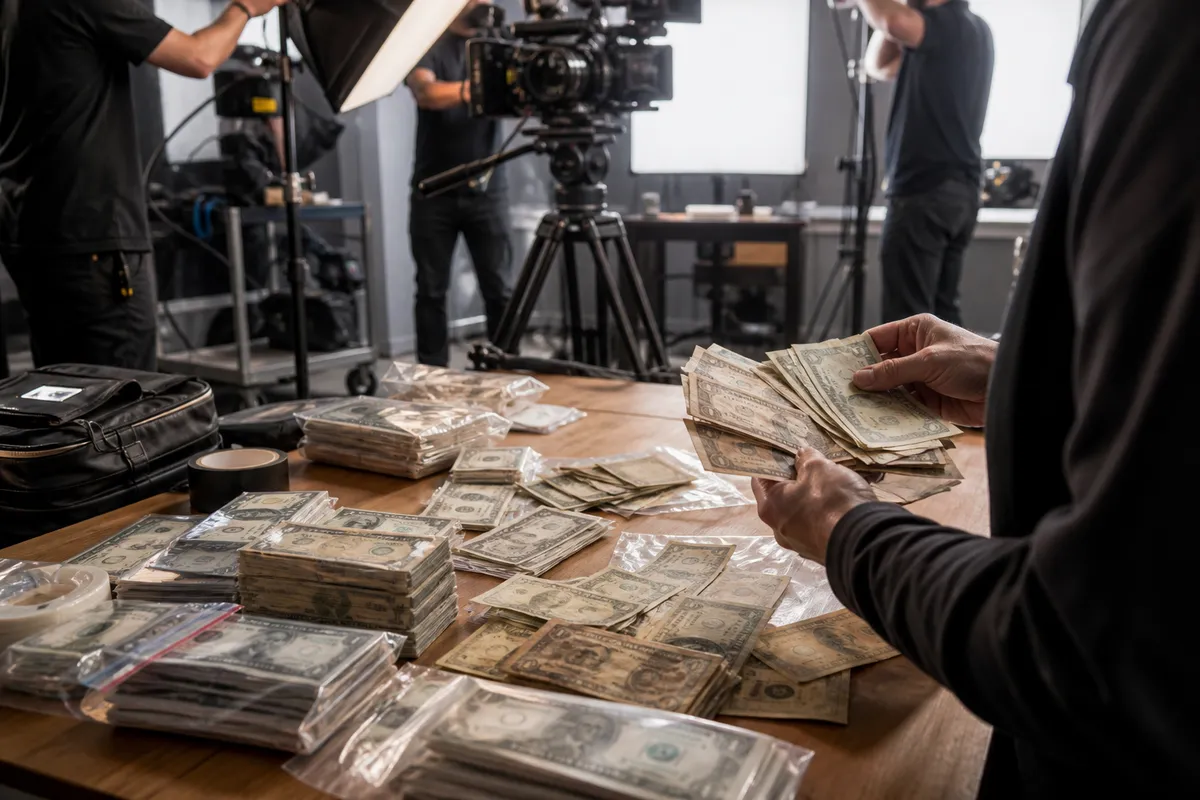
Prop money is specially designed currency for use in films, television shows, photoshoots, and events. It serves a clear purpose: to provide a realistic representation of money without the legal risks associated with counterfeit currency. Prop money is legally distinct from counterfeit money, which is intended to deceive and is punishable by law. In fact, creating or using counterfeit currency can result in fines and up to 20 years in prison (3).
One of the strongest advantages of prop money is that it is marked for legal use. It must be clearly labeled with phrases like "FOR MOTION PICTURE USE ONLY" or "COPY," ensuring that it is not confused with real currency (2). This compliance with U.S. law helps safeguard users from accidental legal issues. Additionally, prop money must adhere to specific size requirements, being either 75% smaller or 150% larger than actual U.S. currency (1).
Using prop money eliminates the risk of legal consequences tied to counterfeit currency. The U.S. Secret Service actively investigates counterfeit cases, and the penalties for using fake money can be severe (3). Prop money is safe for filmmakers, photographers, and event organizers who need to create realistic scenes without crossing legal boundaries.
In summary, prop money is the safest option for those needing realistic currency representations for legal purposes.
Types of Prop Money: Full Print vs. Blank Filler vs. Aged Look
Prop money comes in various types, each designed for specific uses. Understanding these types can help in choosing the right one for film production or photoshoots.
Full Print Prop Money is detailed and realistic. It features accurate designs, textures, and colors similar to real currency. This type is ideal for close-up shots where every detail counts. Common denominations include $20, $50, and $100 bills, available in various stack sizes like single bills or five-stack bundles. The price typically ranges from $20 to $100, depending on quality and brand.
Blank Filler Prop Money is plain and designed for bulk use. It lacks detailed printing and is often used for background stacks where realism is less critical. This type is suitable for scenes that require large amounts of cash without needing close inspection. It generally comes in denominations like $100 and is priced lower, around $15 to $50.
Aged Look Prop Money mimics worn or vintage currency. This type is great for period pieces or scenes requiring a sense of history. Aged look prop money is often more expensive, ranging from $30 to $120, due to its detailed aging process. Denominations can vary widely, and it is often sold in smaller stacks.
In summary, full print is best for detailed shots, blank filler for background use, and aged look for vintage scenes. Choose based on your specific needs and budget.
Top 5 Most Realistic Prop Money Brands in 2024 (With Pricing & Features)
Choosing the right prop money brand can enhance the realism of any production. Here are five top brands to consider in 2024.
1. PropMoney.com
Material: High-quality paper
Realism: Very high, detailed designs
Durability: Good, withstands handling
Customization: Limited options available
Pricing: $2,000 stack for $150, $5,000 stack for $300
Pros: High realism, ideal for close-ups
Cons: Higher cost compared to other brands
2. Vice Props
Material: Specialty paper
Realism: High, good color accuracy
Durability: Durable for multiple uses
Customization: Custom designs available
Pricing: $1,000 stack for $80, $5,000 stack for $350
Pros: Bulk discounts available, good for larger productions
Cons: Slightly less detailed than top-tier brands
3. NewRuleFX
Material: Premium paper
Realism: Very high, fine details
Durability: Excellent, designed for film
Customization: Custom orders possible
Pricing: $1,000 stack for $100, $4,000 stack for $400
Pros: Great for professional use, high-quality
Cons: Pricey for small projects
4. Hollywood Prop Money
Material: Standard paper
Realism: Medium, good for background use
Durability: Fair, best for limited handling
Customization: Limited customization options
Pricing: $500 stack for $40, $2,000 stack for $150
Pros: Affordable for smaller budgets
Cons: Less realistic for close-up shots
5. Prop Movie Money
Material: High-quality, textured paper
Realism: High, closely resembles real bills
Durability: Good, holds up well in productions
Customization: Basic customization available
Pricing: $1,000 stack for $90, $5,000 stack for $350
Pros: Good quality at a reasonable price
Cons: Customization options are limited
Each brand has its strengths and weaknesses. Consider your specific needs and budget when selecting prop money for your project.
How to Spot High-Quality Prop Money (Checklist for Buyers)
When purchasing prop money, a few key factors determine its quality and legality. Here’s a checklist to help identify high-quality options:
Paper Quality: Look for high-quality paper or polymer that mimics the texture of real currency. Genuine U.S. currency has a slightly rough texture due to its printing process (4).
Color Accuracy: Ensure the colors match authentic bills. Compare with real currency under good lighting for the best assessment.
Security Features: Check for watermarks, microprinting, and other security features typically found in real banknotes. These add realism and are a sign of quality (4).
Legal Disclaimers: Verify that the prop money is clearly marked with phrases like “Motion Picture Use Only” or “Copy” to comply with U.S. law (2) (5).
Red Flags to Avoid
Be cautious of the following warning signs when selecting prop money:
No Disclaimer: If the money lacks legal disclaimers, it may be counterfeit.
Too Cheap: Extremely low prices often indicate low quality or illegality.
No Reviews: Lack of customer feedback can signal a subpar product.
Comparison Table of Top Brands
| Brand | Material | Realism Score | Price Range | Legal Compliance |
|---|---|---|---|---|
| PropMoney.com | High-quality paper | Very High | $150-$300 | Meets all legal requirements |
| Vice Props | Specialty paper | High | $80-$350 | Complies with regulations |
| NewRuleFX | Premium paper | Very High | $100-$400 | Fully compliant |
| Hollywood Prop Money | Standard paper | Medium | $40-$150 | Legal use marked |
| Prop Movie Money | Textured paper | High | $90-$350 | Clearly marked |
Choosing high-quality prop money ensures legal compliance and enhances production value. Prioritize these factors to make an informed decision.
Where to Buy Prop Money: Online Stores vs. Local Pickup
When deciding where to buy prop money, consider the differences between online stores and local options. Online retailers like PropMoney.com, Amazon, and eBay offer a wide variety of prop money types, including high-quality options and bulk purchases. The convenience of online shopping allows for easy comparisons and the ability to read customer reviews. However, shipping times can delay access to your prop money, which may be inconvenient for last-minute projects.
Local stores such as Walmart, Target, and specialized prop shops provide the advantage of immediate pickup. This option is useful for those who need prop money quickly. However, local retailers often have a limited selection, which may not include the most realistic or specific types of prop money needed for particular productions.
Online options tend to have a broader range of products, including various denominations and styles. For example, bulk purchasing online can save money in the long run, especially for larger productions. Prices for online purchases can range significantly, often from $20 to $300, depending on the quality and quantity of the prop money.
Local stores may offer lower prices for smaller quantities, but the realism may not match that of specialized online brands. Trusted sellers include PropMoney.com and Vice Props, known for their high-quality products.
For those who prioritize convenience and quick access, local pickup is suitable. However, for a more extensive selection and potentially better quality, online stores are often the better choice.
Prop Money vs. Counterfeit: Legal and Practical Differences
Understanding the legal distinctions between prop money and counterfeit currency is essential. Prop money is legal for use in film, training, or display, while counterfeit money is illegal and intended to deceive. The penalties for using counterfeit currency can be severe: fines and up to 20 years in prison (3).
Visually, prop money is designed to be distinctly different from real currency. It must be marked with phrases such as “Motion Picture Use Only” or “Copy” to ensure it cannot be mistaken for genuine money (2) (5). Additionally, prop money must be either 75% smaller or 150% larger than actual U.S. bills (1). Counterfeit bills, on the other hand, may lack such disclaimers and often attempt to replicate security features like watermarks and color-shifting ink, which can lead to legal issues if used improperly.
The legal ramifications of using counterfeit money can result in significant consequences. For example, the U.S. Secret Service actively investigates counterfeit cases, and recent reports showed a decline in counterfeit currency circulation (6) (7). However, large seizures still occur, such as over $6.5 million in fake currency marked as “prop money” that closely resembled real bills (8).
In summary, prop money is a safe and legal option for those needing realistic currency representations, while counterfeit money poses serious legal risks.
How to Use Prop Money Safely (Avoiding Mistakes and Legal Issues)
Using prop money requires caution to avoid legal troubles and misunderstandings. Always remember: never use prop money in real transactions. This is a fundamental rule. Mixing prop money with actual currency can lead to serious legal consequences, including fines or imprisonment for counterfeiting (3).
To prevent public confusion, only use prop money in controlled environments, such as film sets or photo shoots. Avoid using prop money for pranks or in situations where it might be mistaken for real currency. This can lead to unintended panic or legal issues.
Store prop money securely to prevent misuse. Keep it in a safe place, away from children or anyone who might not understand its purpose.
Common mistakes include not checking local laws regarding prop money use. Regulations can vary by state or municipality. Always research before purchasing or using prop money.
Imagine a scenario where someone mistakes your prop money for real currency. In such a case, calmly explain that it is prop money and show any legal disclaimers visible on the bills. If necessary, contact local authorities to clarify the situation and avoid escalation.
Being informed and cautious ensures that prop money can be used safely and effectively without crossing legal boundaries.
Pros and Cons of High-Quality Prop Money
- Strengths
- Ideal for close-up shots due to very high realism and fine details
- Durable enough to withstand repeated handling during film production
- Clearly marked with legal disclaimers to comply with U.S. law [2][5]
- Available in bulk for larger productions, reducing long-term costs
- Uses high-quality paper or textured materials to mimic real currency
- What doesn't
- Higher cost compared to lower-quality options, ranging from $150 to $400 for a stack
- Limited customization options for most top-tier brands
- Smaller stacks may not cover large-scale production needs
- Pricing can vary widely, making budget planning more complex
- Not suitable for real transactions under any circumstances
Who Should Choose What
Need close-up realism for film
Pick PropMoney.com or NewRuleFX. Their high-quality paper and fine details ensure bills look authentic even under scrutiny.
Running a large production on a budget
Vice Props offers bulk discounts with solid realism. A $5,000 stack for $350 keeps costs down without sacrificing too much quality.
Want premium quality for professional use
NewRuleFX delivers very high realism and durability. Its $1,000 stack for $100 is ideal for filmmakers who prioritize authenticity.
Need affordable props for background scenes
Hollywood Prop Money works well for limited handling. A $2,000 stack for $150 fits smaller budgets.
Balancing cost and quality for mid-sized projects
Prop Movie Money provides high realism at a reasonable price. A $1,000 stack for $90 offers a practical middle ground.
So Which Prop Money Should You Buy
For most film or photo projects, PropMoney.com or NewRuleFX deliver the best realism and legal compliance. Their high-quality paper and fine details hold up under close inspection.
Need bulk on a budget? Vice Props offers solid realism at lower prices, like a $5,000 stack for $350. For quick, low-cost background use, Hollywood Prop Money works but lacks durability for heavy handling.
Avoid any unmarked bills or suspiciously cheap offers—these risk crossing into counterfeit territory. Always check for “Motion Picture Use Only” disclaimers to stay legal.
For a deeper look at high-end options, see Premier Bills Counterfeit Money Explained.
Good to know
Does fake money still exist?
Yes, counterfeit money still circulates, though its volume has declined. The Federal Reserve estimates counterfeit $100 notes in circulation in 2023 ranged from $2.8 million to $8.5 million, an 85% drop since 1996 (6). The $100 bill remains the most counterfeited denomination (7).
What to spray on fake money?
No spray can legally turn fake money into prop money. Prop money must be 75% smaller or 150% larger than real bills, one-sided, and marked with disclaimers like 'Motion Picture Use Only' (1) (2). Spraying real currency or unmarked bills violates federal law (3).
How do you spot fake money?
Check for security features: watermarks, color-shifting ink (e.g., copper to green), and security threads. Genuine U.S. bills also have a slightly rough texture due to their paper composition (4). Counterfeit notes often lack these details.
Which currency is most easy to counterfeit?
The $100 U.S. bill is historically the most counterfeited denomination, with an estimated stock of $2.8–$8.5 million in circulation in 2023 (6) (7). Smaller denominations like $20 and below have the lowest estimated volume of high-quality counterfeits, totaling at most $2 million annually (6).
Best fake money to buy
For film or photos, choose legally compliant prop money from brands like PropMoney.com or NewRuleFX. Their products feature high realism, legal disclaimers, and meet size requirements (75% smaller or 150% larger than real bills) (1) (2).
Prop money near me
Local stores like Walmart or Target may carry basic prop money, but selections are limited. Specialized prop shops offer better quality but may not stock the most realistic options. For the best variety, online retailers like PropMoney.com are recommended.
Prop money in store
In-store options include Walmart, Target, or prop shops, but realism and legal compliance vary. Check for disclaimers like 'Copy' or 'Motion Picture Use Only' to ensure legality (2). Online stores typically provide higher-quality, compliant prop money.
Sources and further reading
- Cinema Law: Can I Film U.S. Currency? (MovieMaker Magazine, citing 18 U.S. Code § 504 and 31 CFR 411)
- U.S. Currency's Starring Role in Film (Federal Reserve Bank of San Francisco, 2019)
- 18 U.S. Code Chapter 25 - Counterfeiting and Forgery
- Quick Glance Reference Card (U.S. Currency Education Program, 2024)
- eCFR: 19 CFR Part 12 - Counterfeit Coins, Obligations, and Other Securities
- Estimating the Volume of Counterfeit U.S. Currency in Circulation (Federal Reserve, 2023)
- Currency in Circulation (U.S. Currency Education Program, 2024)
- Philadelphia CBP Officers Seize More than $6.5 Million in Fake Currency from Russia (CBP, 2023)