Fake us dollar 100
- First published:
- 13 min read
Why Do People Counterfeit $100 Bills?
Counterfeiting $100 bills is a prevalent issue. In fact, it is the most frequently counterfeited denomination in the U.S. In fiscal year 2023, the U.S. Secret Service reported that $102 million in counterfeit currency was passed globally, highlighting the scale of this problem (1). The estimated stock of counterfeit $100 bills in circulation ranged from $2.8 million to $8.5 million in 2023, a significant decline from 1996, when the volume was much higher (1).
Historically, the $100 bill has attracted counterfeiters due to its high value and global circulation. The term "Superdollar" refers to exceptionally high-quality counterfeit $100 notes that have been circulated, particularly in the 1980s and 1990s. Technological advances in digital printing have made it easier for counterfeiters to produce convincing replicas of these bills.
The $100 bill includes several security features designed to deter counterfeiting. These include a 3-D Security Ribbon, color-shifting ink, and a security thread that glows pink under UV light (2). Despite these advancements, counterfeiters continue to exploit weaknesses in the detection methods available to the public.
Legal consequences for counterfeiting are severe. Under U.S. law, individuals caught passing or possessing counterfeit currency can face up to 20 years in prison (3). This serves as a deterrent, but the allure of profit keeps some individuals engaged in this illegal activity.
Understanding the reasons behind the counterfeiting of $100 bills sheds light on the complexities of currency security and the ongoing battle against counterfeit money.
Key Security Features of a Real $100 Bill
Recognizing the security features of a real $100 bill is essential to avoid counterfeit money. Here are the key features you should look for:
Color-Shifting Ink
The $100 bill has a color-shifting bell in the inkwell that changes from copper to green when tilted. This feature creates a dynamic visual effect that is hard to replicate (2).
Watermark
A watermark of Benjamin Franklin is visible from both sides when the bill is held up to light. It is located to the right of Franklin's portrait and includes the text "100" embedded within it (4).
Security Thread
The security thread is embedded vertically to the left of Franklin’s portrait. It reads "USA 100" and glows pink under ultraviolet light, making it a reliable indicator of authenticity (2).
Microprinting
Microprinting is found in various locations on the bill. Notably, the text "THE UNITED STATES OF AMERICA" is printed on Franklin’s jacket collar, while "USA 100" appears around the portrait watermark (2).
Raised Printing
The $100 bill features raised printing, giving it a distinct texture. This is noticeable when the bill is rubbed between fingers, as it feels slightly rough (4).
3D Security Ribbon
The 3D Security Ribbon displays images of bells and 100s that appear to move when the bill is tilted. This ribbon is woven into the paper, not printed, making it difficult for counterfeiters to replicate (2).
UV Glow
Under ultraviolet light, certain elements of the bill glow. The security thread, for instance, illuminates pink, providing an additional layer of verification (2).
Conclusion
To ensure the authenticity of a $100 bill, examine these features carefully. Each element plays a crucial role in distinguishing real currency from counterfeit notes.
Step-by-Step Guide: How to Spot a Fake $100 Bill
Identifying a fake $100 bill requires careful examination of its features. Follow this actionable checklist to verify authenticity.
Feel the Texture
The paper of a genuine $100 bill consists of 75% cotton and 25% linen. It should feel slightly rough due to raised printing. Run your fingers over the bill's surface to notice this texture (4).
Tilt the Bill
Tilt the bill and observe the 3-D Security Ribbon. This ribbon should display images of bells and 100s that appear to move. If the ribbon looks flat or printed, it’s likely a counterfeit (2).
Check Color-Shifting Features
Look at the color-shifting bell in the inkwell. It should change from copper to green when tilted. If the color does not shift, the bill may not be genuine (2).
Hold it to the Light
When held up to light, a real $100 bill shows a watermark of Benjamin Franklin. This watermark should be visible from both sides and include the number "100" (4).
Examine the Security Thread
The security thread is embedded vertically and reads "USA 100." Under UV light, it glows pink. If this thread is absent or does not glow, the bill is likely fake (2).
Inspect for Microprinting
Genuine $100 bills contain microprinting. Look for the text "THE UNITED STATES OF AMERICA" on Franklin’s jacket collar and "USA 100" around the portrait watermark (2).
Avoid Relying Solely on Detection Pens
Counterfeit detection pens are unreliable for $100 bills. They only indicate the presence of starch in the paper, which can be mimicked by counterfeiters using starch-free paper.
Common Mistakes to Avoid
Don’t rely solely on one method for verification. Use a combination of the above techniques for the best results. Failing to perform multiple checks can lead to overlooking a counterfeit.
By following these steps, you can confidently assess the authenticity of a $100 bill. Remember, if you suspect a counterfeit, do not pass it on; report it to local law enforcement or the nearest U.S. Secret Service field office (5).
Common Red Flags in Fake $100 Bills
Detecting counterfeit $100 bills involves identifying visual and tactile inconsistencies. Here are some common red flags to watch for:
Visual Inconsistencies
Blurry Printing: Genuine bills have sharp, clear printing. If the text or images appear fuzzy or smudged, it may be fake.
Incorrect Colors: Authentic $100 bills have specific color shades. If the green is too bright or dull, suspect a counterfeit.
Missing Security Features: Key features such as the 3-D Security Ribbon and color-shifting ink should be present. If these elements are absent or poorly executed, the bill is likely counterfeit.
Tactile Inconsistencies
Texture: Real $100 bills are made from a unique blend of 75% cotton and 25% linen. They feel slightly rough due to raised printing. Counterfeit bills often feel smooth or different in texture.
Weight: Genuine bills have a specific weight due to their material. If a bill feels lighter or heavier, it may not be authentic.
Examples of Counterfeits
Low-quality counterfeits often lack several security features and may have obvious visual flaws. For instance, a fake bill might show a poorly printed 3-D Security Ribbon that does not move when tilted.
High-quality counterfeits, sometimes referred to as "Superdollars," can closely mimic real bills. These may include accurate colors and textures but still fail on details like microprinting or the UV glow of the security thread.
What to Do If You Suspect a Counterfeit
If you suspect a bill is fake, do not attempt to pass it on. Instead, contact local law enforcement or the nearest U.S. Secret Service field office to report your findings (5).
Being aware of these red flags can help the reader identify counterfeit $100 bills effectively.
Tools to Verify a $100 Bill (And Which Ones Don’t Work)
When it comes to verifying the authenticity of a $100 bill, having the right tools can make a significant difference. Some tools are reliable, while others may lead you astray.
Reliable Tools for Verification
UV Light: A UV light is effective for checking the security thread embedded in the bill. This thread glows pink under ultraviolet light, providing a quick verification method (2). You can purchase UV lights at office supply stores or online retailers.
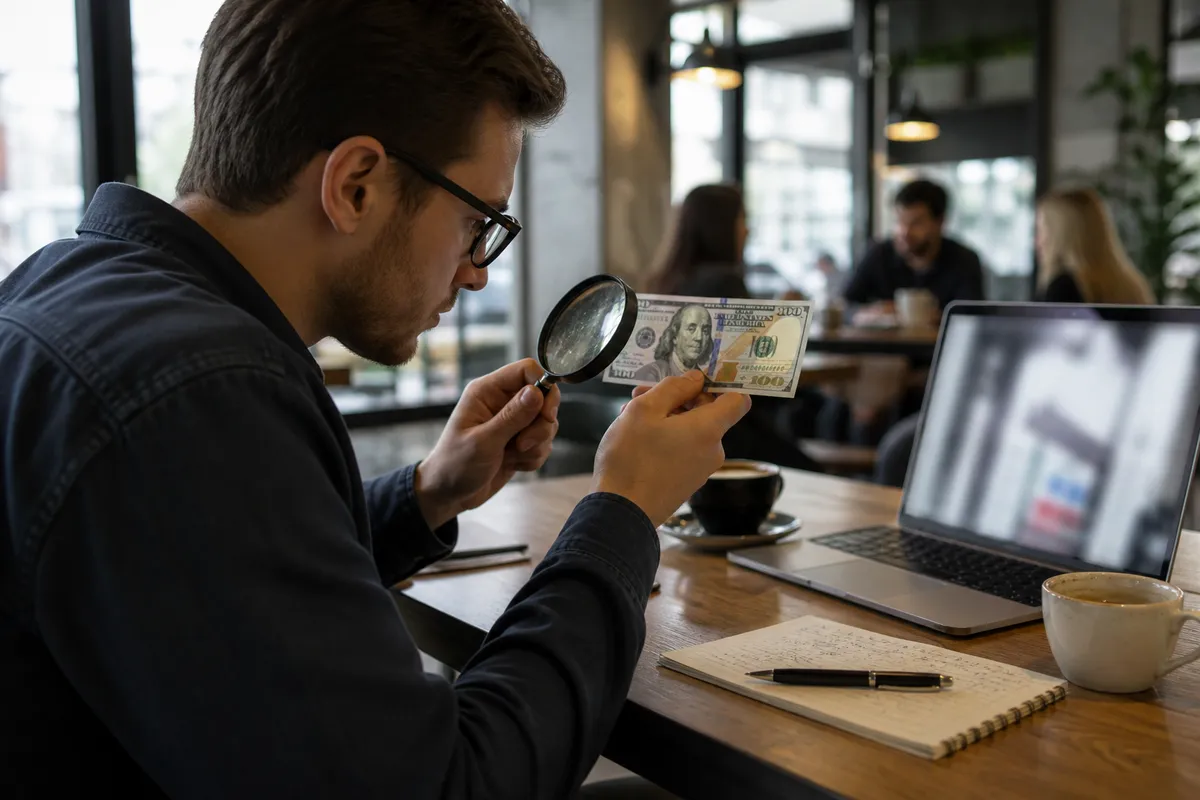
Magnifying Glass: Using a magnifying glass allows you to inspect microprinting on the bill. Look for the text "THE UNITED STATES OF AMERICA" on Franklin’s jacket collar and "USA 100" around the watermark (2). These details are difficult for counterfeiters to replicate accurately.
3D Security Ribbon Checker: This tool helps examine the 3D Security Ribbon, which displays images of bells and 100s that appear to move when tilted (2). A simple tilt will confirm if the ribbon is genuine.
Feel Test: While not a tool in the traditional sense, using your fingers to feel the texture of the bill is crucial. Genuine $100 bills have a distinctive rough texture due to raised printing (4).
Tools to Avoid
Counterfeit Detection Pens: These pens are not reliable for identifying fake $100 bills. They only test for starch in the paper, which can be mimicked by counterfeiters using starch-free paper. Relying on these pens may give a false sense of security.
Where to Get These Tools
You can find reliable verification tools at various locations:
Banks: Many banks have UV lights available for customers to use.
Office Supply Stores: Stores like Staples or Office Depot carry UV lights and magnifying glasses.
Online Retailers: Websites such as Amazon offer a wide range of verification tools.
Using the right tools can enhance your ability to spot counterfeit $100 bills effectively. Always combine multiple methods for the best results.
What to Do If You Suspect a Fake $100 Bill
When encountering a suspected counterfeit $100 bill, immediate action is necessary. First, do not attempt to pass it on. Passing counterfeit currency is illegal and can lead to severe consequences. Under U.S. law, individuals caught knowingly passing counterfeit money can face up to 20 years in prison (3).
Legal Steps to Take
Do Not Pass It On: If you suspect a bill is fake, do not use it in any transactions. This protects you from legal repercussions and prevents the spread of counterfeit money.
Contact Local Law Enforcement: Reach out to your local police department. They can provide guidance and take necessary actions regarding the counterfeit bill.
Notify the U.S. Secret Service: The Secret Service is responsible for investigating counterfeiting. You can contact the nearest Secret Service field office to report the counterfeit bill. They take such reports seriously and can assist in further investigations (5).
Follow Bank Procedures: If you received the bill from a bank, return it to them immediately. Banks have procedures for handling suspected counterfeit currency and can guide you on the next steps.
Official Resources
U.S. Secret Service Website: For detailed information on reporting counterfeit currency, visit the U.S. Secret Service website. They provide resources on how to identify and report counterfeit bills.
Local Banks: Many banks have staff trained to recognize counterfeit bills. They can help verify the authenticity of the bill and inform you about local procedures for reporting.
Currency Education Programs: Familiarize yourself with the U.S. Currency Education Program. They offer valuable insights into the security features of the $100 bill and how to recognize counterfeits (4).
Taking these steps ensures proper handling of suspected counterfeit currency and contributes to the broader effort to combat counterfeiting. Always prioritize safety and legality when dealing with suspicious currency.
Myths and Misconceptions About Fake $100 Bills
Many myths surround counterfeit $100 bills, leading to confusion about their detection and characteristics. One common misconception is that "all fake bills are easy to spot." While some counterfeits are poorly made, high-quality fakes can closely resemble real bills. In fact, the $100 bill is the most frequently counterfeited denomination, with an estimated $2.8 million to $8.5 million in counterfeit $100 bills in circulation as of 2023 (1).
Another myth is that the blue line on the $100 bill is a security feature. This is not accurate. The blue line, or 3-D Security Ribbon, is indeed a feature, but it is just one of many security elements. Genuine ribbons display images of bells and "100s" that move when tilted, making them difficult to replicate (2).
Older designs of the $100 bill differ significantly from newer ones, leading to misconceptions about their authenticity. For instance, the new design includes advanced security features like a color-shifting bell in the inkwell and a security thread that glows pink under UV light (2). Older bills lack these features, so familiarity with the current design is crucial.
Microprinting is another feature that is often overlooked. Genuine bills contain tiny text that is hard to replicate, such as "THE UNITED STATES OF AMERICA" on Franklin's jacket collar (2). Many counterfeiters fail to include such details, making this a reliable verification method.
When assessing a $100 bill, remember that relying on a single method can lead to errors. Use a combination of features to ensure authenticity.
Understanding these myths can equip the reader with better tools to identify genuine versus counterfeit $100 bills effectively.
Common Mistakes and Misconceptions
Relying on the Blue Line as the Only Security Feature
Many assume the blue line on a $100 bill is enough to confirm its authenticity. The 3-D Security Ribbon does contain moving images of bells and 100s when tilted, but it’s just one feature (2). A fake bill might mimic the line without the dynamic effect.
The ribbon must shift when tilted to be genuine.
Trusting Detection Pens Completely
Counterfeit detection pens are often seen as foolproof. They only check for starch in the paper, which counterfeiters can bypass by using starch-free materials. A pen’s mark doesn’t guarantee authenticity.
Use multiple verification methods instead.
Ignoring the Watermark
Some skip checking the watermark, assuming it’s too subtle to matter. A real $100 bill has a visible Benjamin Franklin watermark from both sides when held to light (4). Missing or faint watermarks signal a counterfeit.
Always hold the bill up to a light source.
Overlooking Microprinting
Microprinting is easy to miss without close inspection. Genuine bills have tiny, precise text like “THE UNITED STATES OF AMERICA” on Franklin’s collar (2). Counterfeiters often skip or blur these details.
A magnifying glass helps spot them.
Assuming All Counterfeits Are Low-Quality
High-quality fakes, or “Superdollars,” can deceive even trained eyes. The $100 bill remains the most counterfeited, with millions in circulation annually (1). Even sharp details don’t always guarantee legitimacy.
Combine tactile, visual, and UV checks for accuracy.
Key Takeaways
Genuine $100 bills have sharp printing, correct colors, and security features like the 3-D ribbon and color-shifting ink
Always check texture, weight, and microprinting—counterfeits often fail here
UV lights and magnifying glasses are reliable tools, but detection pens are not
If you suspect a fake, do not pass it on; contact law enforcement or the U.S. Secret Service
Combine multiple verification methods for the best results
For a deeper understanding of counterfeit detection, explore Fake US Dollars: How to Spot Them.
Good to know
How to tell if a $100 USD bill is real?
Tilt the bill to check the 3-D Security Ribbon with moving bells and 100s, woven into the paper (2). Look for the color-shifting bell in the inkwell that changes from copper to green (2). Hold it to light to see the embedded security thread reading 'USA 100' and glowing pink under UV (2).
Is it true that my $100 bill doesn't have a blue line?
The $100 bill has a 3-D Security Ribbon, not a plain blue line. Genuine ribbons display moving images of bells and 100s when tilted (2). If the line is static or lacks these details, the bill may be counterfeit.
How to check if a bill is real?
Use the 'Feel, Tilt, Check' method: feel the raised printing and texture, tilt to see color-shifting features, and check the watermark and security thread under light (4). Always verify multiple features, as counterfeits often fail on one or more.
Can a counterfeit detection pen be trusted?
No. Detection pens only check for starch in the paper, which counterfeiters can avoid by using starch-free materials. They do not guarantee authenticity and should not be the sole verification method.
Sources and further reading
- Estimating the Volume of Counterfeit U.S. Currency in Circulation
- $100 Note Security Features | U.S. Currency Education Program
- 18 U.S.C. § 472: Uttering Counterfeit Obligations or Securities
- Decoding Dollars $100 | U.S. Currency Education Program
- Reporting Suspected Counterfeit Currency to the United States Secret Service