Navigating the World of Counterfeit US Currency
- First published:
- 14 min read
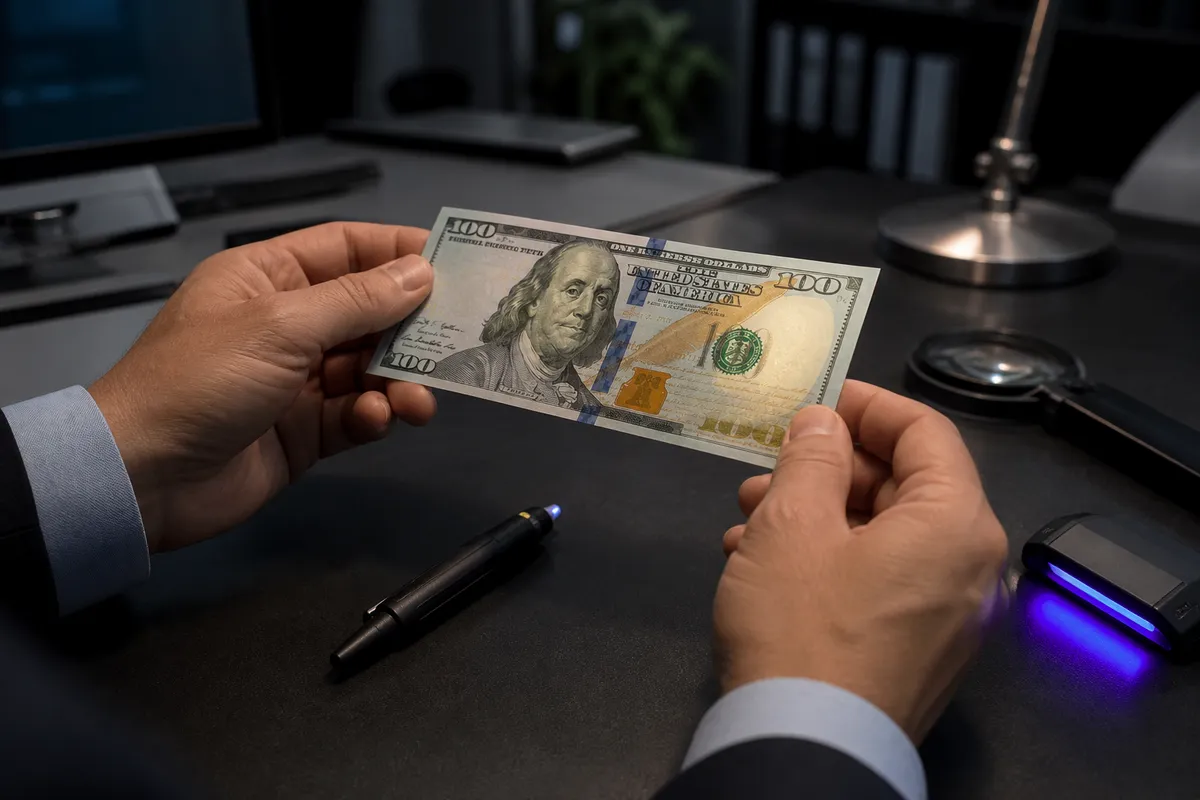
What Is Counterfeit US Currency?
Counterfeit US currency refers to any banknote or coin that is not genuine and is produced without legal authorization. This illegal activity is defined under Title 18, Section 471 of the U.S. Code, making it a federal crime to manufacture, distribute, or possess counterfeit currency (1). The U.S. Secret Service, which is tasked with investigating counterfeiting, reported that in fiscal year 2023, approximately $102 million in counterfeit currency was passed in the United States, highlighting the ongoing threat despite advancements in security features (2).
Counterfeiting continues to be a persistent issue primarily because higher denominations, such as the $50 and $100 bills, are often targeted. The $100 bill is the most counterfeited currency globally, with thousands of fake notes seized annually, amounting to face values exceeding $100 million in 2023 (3). The ease of replicating these higher-value bills, combined with their widespread use, makes them attractive to counterfeiters.
Historically, counterfeiters have employed various techniques to create fake currency. One common method involves using bleached lower-denomination bills to produce higher-value counterfeits. This practice allows criminals to exploit the original paper's texture while avoiding the costs associated with producing entirely new counterfeit notes (5).
To combat this issue, the U.S. Secret Service advises the public to be vigilant and to familiarize themselves with security features present on genuine currency, such as watermarks, color-shifting ink, and security threads (4). Using counterfeit detection pens is not reliable, as they can yield false results; thus, examining the currency's physical attributes is essential for verification (6).
Understanding the nature of counterfeit currency and its implications can help individuals recognize and report suspicious notes effectively.
How Counterfeit Money Is Made: Common Techniques
Counterfeit money can be produced using various methods that range from low-tech to high-tech techniques. Low-tech methods often involve color copiers and inkjet printers. These tools allow counterfeiters to print fake bills quickly and cheaply. However, the limitations of this approach are significant. The resulting currency often lacks the unique texture and security features found in genuine notes, making it easier to detect (4).
On the other hand, high-tech counterfeiting techniques have become more sophisticated. One common method involves using bleached genuine bills. Criminals take lower-denomination notes, bleach them, and then print higher denominations on the same paper. This technique preserves the authentic texture and feel of genuine currency (5). Advanced printing methods on specialty paper also exist, which can mimic the unique properties of real banknotes, including the embedded security threads and watermarks (4).
Digital tools play a crucial role in modern counterfeiting. Scanners and graphic design software enable counterfeiters to create high-quality replicas of banknotes. These digital resources allow for more precise reproduction of security features such as microprinting and color-shifting ink, which are crucial for authenticating U.S. currency (4) (7). The sophistication of these methods poses a constant challenge for law enforcement, as counterfeiters adapt to new security measures.
For those handling cash, being aware of these techniques can aid in identifying counterfeit currency. Familiarizing oneself with the security features of genuine notes is essential.
Understanding how counterfeit money is made helps in recognizing and preventing the circulation of fake currency.
Key Security Features of Genuine US Currency
Recognizing the security features of genuine US currency is crucial in distinguishing real bills from counterfeits. Here are the key features to look for:
Watermark
A watermark is a recognizable feature visible when the bill is held up to light. For bills of $10 and higher, the watermark matches the portrait on the note. The $5 bill has two watermarks of the numeral 5, making it unique.
Security Thread
Embedded vertically in denominations of $5 and higher, the security thread glows different colors under ultraviolet (UV) light. Each denomination has a uniquely positioned thread, which can help in verifying authenticity. For example, the $5 note glows blue, while the $100 note glows pink under UV light (4).
Color-Shifting Ink
Found on the $100 bill, this ink changes color when the note is tilted. It shifts from copper to green in the lower right corner, adding an additional layer of security to this commonly counterfeited denomination (4).
3-D Security Ribbon
The $100 bill also features a 3-D security ribbon that displays images of bells and the number 100 that move when the note is tilted. This ribbon is a distinctive feature that is not present on lower denominations (4).
Microprinting
Microprinting appears in several locations on denominations of $5 and higher. It includes phrases like "THE UNITED STATES OF AMERICA" or "USA," which are only visible under magnification. This fine detail makes counterfeiting more difficult (4).
Texture
Genuine US currency is made from a blend of 75% cotton and 25% linen, giving it a unique texture. The paper feels slightly rough due to the intaglio printing process, which is another way to identify real bills (4).
UV Glow
Many security features, including the security thread, have specific UV properties. Under UV light, different denominations will exhibit unique glowing characteristics, aiding in their verification.
Before accepting cash, especially larger bills, check for these features. If a bill seems suspicious, use the "Feel, Tilt, Check" method recommended by the US Secret Service to verify authenticity (7).
Understanding these features can significantly reduce the risk of accepting counterfeit currency.
How to Spot Counterfeit Bills: Step-by-Step Guide
Identifying counterfeit currency can be straightforward if you know what to look for. Use this checklist to help authenticate U.S. banknotes effectively.
Checklist for Spotting Counterfeit Bills
Feel the Texture: Genuine U.S. currency has a unique texture made of 75% cotton and 25% linen. It should feel slightly rough due to the intaglio printing process (4).
Look for Watermarks: Hold the bill up to the light. For $10 bills and higher, the watermark should match the portrait on the note. The $5 bill features two watermarks of the numeral 5 (4).
Tilt for Color-Shifting Ink: On the $100 bill, tilt the note to observe the color-shifting ink in the lower right corner. It should change from copper to green (4).
Check for Security Threads: Look for embedded security threads that glow under UV light. Each denomination has uniquely positioned threads that exhibit different colors (4).
Microprinting: Examine the bill closely for fine print that is only visible under magnification, such as phrases like "THE UNITED STATES OF AMERICA" (4).
UV Glow: Use a UV light to check for specific glowing features. Each denomination will show unique UV responses, aiding in verification (4).
Using a Counterfeit Detection Pen
Counterfeit detection pens can be useful but are not foolproof. The pen works by applying iodine to the bill. If the ink turns brown or black, it suggests that the note may be counterfeit. However, some counterfeiters use bleached bills that can pass this test, leading to false positives (6). Relying solely on this method is not advisable.
Comparison Table: Genuine vs. Counterfeit Features
| Feature | Genuine Currency | Counterfeit Currency |
|---|---|---|
| Texture | Rough, made of cotton and linen | Smooth, lacks authentic feel |
| Watermark | Matches the portrait, visible in light | May not be present or mismatched |
| Color-Shifting Ink | Changes color when tilted | May be absent or static |
| Security Thread | Embedded, glows under UV light | Often missing or poorly replicated |
| Microprinting | Visible under magnification | Often absent or poorly printed |
| UV Glow | Unique properties for each denomination | Lacks distinctive glowing features |
Before accepting any cash, especially larger denominations, ensure you perform these checks. If you suspect a bill is counterfeit, store it separately from genuine currency and report it to local authorities (6).
Being informed about how to spot counterfeit bills can help protect against financial loss.
Most Counterfeited US Dollar Bills: Statistics and Trends
Counterfeit US currency poses a significant threat, and certain denominations are targeted more frequently than others. The US Secret Service reports that the $100 bill is the most counterfeited denomination globally. In 2023, it accounted for thousands of fake notes seized, with total face values exceeding $100 million (3). Following the $100 bill, the $20 and $50 denominations are also commonly counterfeited, primarily due to their higher value and widespread circulation.
Counterfeiters prefer higher denominations for several reasons. Higher-value bills yield more significant returns with fewer notes. For instance, passing a single $100 bill is more profitable than passing multiple lower-denomination bills, such as $5 or $10. The $20 bill is also frequently counterfeited because it is often used in everyday transactions, making it easier to circulate without raising suspicion.
Regional trends in counterfeiting have been observed as well. While the $100 bill is the most counterfeited worldwide, the prevalence of other denominations can vary by location. In some regions, lower denominations may be more common due to specific economic conditions or consumer behavior.
The overall volume of counterfeit currency remains alarming. In fiscal year 2023, the US Secret Service recorded approximately $102 million in counterfeit currency passed in the United States, underscoring the ongoing challenge despite advancements in security features (2).
Understanding which bills are most frequently counterfeited and the reasons behind this targeting can help individuals and businesses remain vigilant. By familiarizing themselves with the characteristics of genuine currency, they can better protect themselves against counterfeit risks.
What to Do If You Receive Counterfeit Money
Receiving counterfeit money can be alarming. Immediate action is essential to avoid further complications. Do not attempt to pass the counterfeit bill to someone else. Instead, take the following steps:
Store the Note Safely: Keep the suspected counterfeit bill separate from genuine currency. This will prevent accidental use.
Note the Source: Try to remember where you received the bill. This information can be crucial for law enforcement.
Contact Local Authorities: Notify your local police department about the counterfeit bill. They can provide guidance on what to do next.
Report to the U.S. Secret Service: The U.S. Secret Service is responsible for investigating counterfeiting. You can reach them through local field offices. As of November 1, 2024, electronic submissions of suspected counterfeit currency are no longer accepted via the USDollars website (8).
Legal obligations also come into play when dealing with counterfeit money. Under Title 18 Section 471 of the U.S. Code, it is illegal to use, pass, or attempt to use counterfeit currency. Attempting to use counterfeit money can lead to serious legal consequences, including fines and imprisonment.
For reporting counterfeit money, you can contact the U.S. Secret Service at their local field office or the nearest police department. The U.S. Secret Service website provides additional resources and information about counterfeit currency and how to report it.
Being aware of the steps to take when receiving counterfeit money can help mitigate risks and assist law enforcement in tackling this issue effectively.
Counterfeit Money in Pop Culture: Legal Prop Money vs. Illegal Fakes
Understanding the distinction between legal prop money and illegal counterfeit currency is crucial, especially in film production and novelty markets. Legal prop money is designed for use in films or theatrical productions, while illegal counterfeit currency is any note or coin produced without legal authorization (1).
Prop money is crafted to avoid confusion with genuine currency. It often features disclaimers, non-standard sizes, or colors that clearly indicate it is not real money. For example, prop bills may have “For Motion Picture Use Only” printed on them, ensuring that they cannot be mistaken for actual currency. Additionally, the color and texture might differ significantly from real U.S. currency, making it easier to identify (1).
Legal uses of prop money include film sets, theater productions, and novelty gifts. Many licensed vendors specialize in creating realistic prop money for these purposes. These vendors ensure their products meet legal requirements, which may vary by state. For instance, some states require prop money to be printed in a specific size or color to avoid confusion with real money.
When searching for prop money, consider reputable sources that provide detailed descriptions and visual examples of their products. This way, you can ensure that the prop money will serve its intended purpose without causing legal issues or misunderstandings.
Being informed about the differences between legal prop money and illegal counterfeits can help prevent inadvertent legal trouble. Always choose licensed vendors for purchasing prop money to stay compliant with the law.
Common Misconceptions and Mistakes
Trusting counterfeit detection pens alone
Many rely on counterfeit detection pens as a quick check. These pens react with the paper’s starch, turning dark if counterfeit. However, they can give false results, especially with bleached genuine bills used as counterfeits (6). Always combine pen tests with other checks like texture, watermarks, or security threads.
Assuming all prop money is illegal
Some believe any fake-looking bill is counterfeit. Legal prop money exists for films, theater, or novelty use, often marked with disclaimers like “For Motion Picture Use Only” or non-standard colors (1). Unlike counterfeit currency, prop money is designed to avoid confusion with real bills.
Ignoring the $100 bill’s security features
The $100 bill is the most counterfeited globally, yet many skip its unique checks. It includes a 3-D Security Ribbon and color-shifting ink that changes from copper to green when tilted (4). Overlooking these features increases the risk of accepting fakes.
Not checking watermarks on lower denominations
Watermarks are often associated with higher denominations, but the $5 bill also has them—two numeral 5 watermarks (4). Skipping this check on smaller bills can lead to missing obvious counterfeits.
Forgetting to report suspected counterfeits properly
Some keep or try to spend suspected counterfeit bills. The correct action is to store the note separately, note its source, and surrender it to local police or the US Secret Service (6). As of November 1, 2024, electronic submissions via the USDollars website are no longer accepted (8).
Believing UV light alone confirms authenticity
UV light reveals security threads and other features, but it’s not foolproof. Some counterfeits replicate UV elements poorly, while others may mimic them well. Always combine UV checks with tactile and visual inspections (4).
Key Takeaways
The $100 bill is the most counterfeited, so always check its 3-D Security Ribbon and color-shifting ink (4).
Counterfeit detection pens are not reliable alone—combine them with texture, watermark, and UV checks (6).
Legal prop money is marked with disclaimers or non-standard designs, unlike illegal counterfeits (1).
If you receive a suspected counterfeit, store it separately, note the source, and report it to authorities (6).
Lower denominations like the $5 bill also have watermarks—don’t skip these checks (4).
Next, learn more about the security features of genuine bills in Fake US Dollars: How to Spot Them.
Good to know
What do the numbers on bills mean?
The serial numbers and plate identifiers on US currency designate when and where a note was printed. These numbers help track and authenticate bills, with each denomination having unique patterns (4).
How can I tell if my cash is real?
Use the 'Feel, Tilt, Check' method: feel the rough texture of cotton-linen paper, tilt for color-shifting ink, and check watermarks or security threads under light (4) (7).
What's the most counterfeited dollar bill?
The $100 bill is the most counterfeited globally, with thousands of fake notes seized annually, including cases exceeding $100 million in face value in 2023 (3).
What is counterfeit currency?
Counterfeit currency is any note or coin produced without legal authorization, as defined by the US Secret Service (1).
How to check if money is real at home
Hold the bill to light to check for watermarks and embedded security threads. Tilt it to see color-shifting ink and feel the texture for cotton-linen roughness (4).
Fake $100 dollar bill vs real
A genuine $100 bill has a 3-D Security Ribbon with moving bells and 100s, color-shifting ink, and a watermark matching the portrait. Counterfeits often lack these or replicate them poorly (4).
How to know original 100 dollar
Look for the 3-D Security Ribbon, color-shifting ink in the lower right corner, and a watermark of Benjamin Franklin visible when held to light (4).
Sources and further reading
- Counterfeit Investigations - US Secret Service
- Estimating the Volume of Counterfeit U.S. Currency in Circulation - Federal Reserve
- World's most counterfeit bank notes revealed - Digital Journal
- Dollars in Detail: Your Guide to U.S. Currency - US Currency Education Program
- FY 2023 Annual Report - US Secret Service
- The Fed - How do I determine if a banknote is genuine? What should I do if I think I have a counterfeit note?
- How to Authenticate U.S. Currency - US Currency Education Program
- Reporting Suspected Counterfeit Currency to the United States Secret Service - US Secret Service