Fake Dollar Bill Template: How to Use It
- First published:
- 15 min read
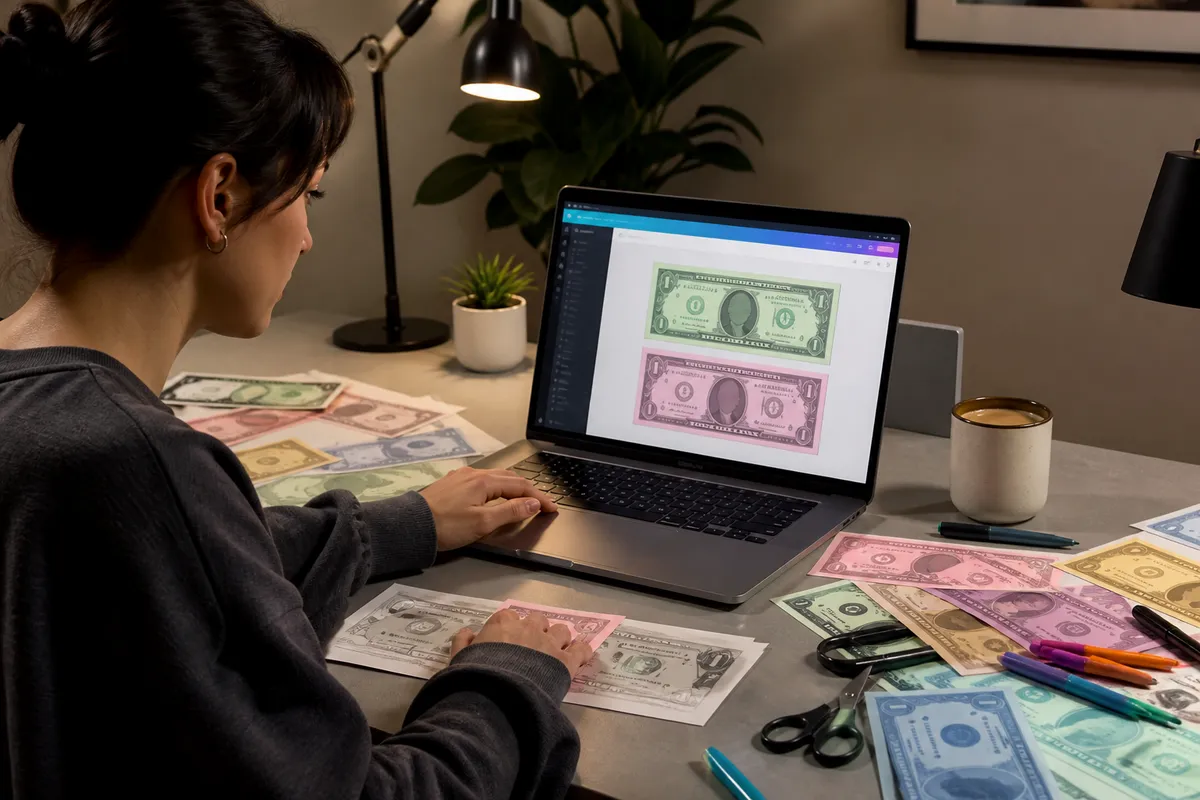
What Is a Fake Dollar Bill Template and Why Use It?
A fake dollar bill template is a design that mimics real U.S. currency. These templates can be printable, editable, or vector-based, allowing users to create their own versions of play money. Common uses include educational tools, film props, and novelty gifts. For example, a teacher might use printable play money to teach students about currency, while filmmakers may need prop money for a scene.
Legal and ethical use cases for these templates are specific. They can serve as props in movies or theater productions, provided they are marked “For Motion Picture Use Only” or “Replica” to distinguish them from real money. Educational play money can help children understand financial concepts in a fun way. Additionally, novelty gifts featuring fake money can add humor to occasions like birthdays or pranks.
However, restrictions are crucial to understand. Using fake dollar bill templates for fraudulent purposes is illegal and can lead to severe consequences. Under 18 U.S. Code § 471, anyone who forges or alters currency with intent to defraud can face up to 20 years in prison (4). Similarly, passing counterfeit currency is punishable by the same penalties (5). It is essential to comply with federal regulations regarding the size and appearance of any fake money. For instance, color illustrations must be less than three-fourths or more than one and one-half the size of real currency (2).
Creating or using fake dollar bill templates should always be for non-criminal purposes. This ensures that the use of such templates remains within legal boundaries.
Using fake dollar bill templates can be fun and educational, as long as the rules are followed.
Types of Fake Dollar Bill Templates Available
Fake dollar bill templates come in various formats, each serving different needs. Common formats include:
PDF: Ideal for high-resolution printing. These templates are often print-ready and do not allow for editing.
Word: Allows for basic customization, but may not maintain high-quality design.
Canva: Offers editable money templates, allowing users to customize colors and text easily.
Vector (AI/PSD): Suitable for graphic designers, these templates can be resized without losing quality.
Image (PNG/JPG): Great for quick use in digital projects but may lack the resolution needed for printing.
Editable templates, like those found in Canva, allow for significant customization, making them suitable for personalized projects. Static templates, such as PDFs, are ready to print but cannot be modified. This distinction is important when choosing a template based on the intended use.
Denominations available in these templates typically range from $1 to $100. Users can find designs that mimic realistic U.S. currency or opt for more cartoonish styles for educational purposes. Blank templates are also available for those who want to create their own designs.
For example, a teacher could use a $10 educational play money template to teach children about budgeting. Filmmakers might prefer a realistic $100 prop money template for a scene.
When selecting a template, consider the legal implications. Templates must adhere to federal guidelines, such as being marked “For Motion Picture Use Only” if used in film. This ensures compliance and avoids potential legal issues related to counterfeiting (1) (2).
Understanding the types of fake dollar bill templates available helps in selecting the right one for your needs.
Where to Find Free and Customizable Fake Dollar Bill Templates
Finding suitable fake dollar bill templates can be straightforward. Several reputable sources offer both free and customizable options. Here are some of the top platforms to consider:
Canva
Canva is a popular graphic design tool that provides a range of editable money templates. Users can utilize its drag-and-drop editor to customize colors, text, and designs easily. Templates can be downloaded in various formats, including PDF, making them ready for high-resolution printing. This flexibility is ideal for creating personalized projects.
PrintablePaper.net
PrintablePaper.net offers a selection of free printable play money templates. These templates are designed for educational purposes, helping children learn about currency in a fun way. Users can print these templates directly from the website without any design software, making it user-friendly for beginners.
TemplateLab
TemplateLab provides various customizable templates, including fake dollar bills. Users can download the templates in Word format, allowing for basic editing. This source is particularly useful for those looking to create tailored designs quickly.
Etsy
Etsy is a marketplace for artists and creators, featuring both free and paid fake dollar bill templates. Many sellers offer unique designs that can be downloaded and printed. This platform is excellent for finding creative and high-quality templates, although some may come at a cost.
Government Educational Resources
The U.S. Currency Education Program offers resources, including play money templates for educational use. These templates comply with federal regulations and are ideal for teaching purposes. The site includes guidelines on how to use these templates legally, ensuring compliance with federal laws regarding currency imitation.
When choosing a template, consider the purpose and legal requirements. Ensure that any fake dollar bill template used for educational or novelty purposes complies with federal regulations. This includes marking the bills appropriately if intended for film use.
Exploring these sources provides a variety of options for finding the right fake dollar bill template tailored to specific needs.
How to Customize a Fake Dollar Bill Template
Creating a customized fake dollar bill template is a straightforward process. Follow these steps to make your own unique version.
Step 1: Choose a Template
Select a template that suits your needs. Options include PDF, Word, or editable formats like Canva. For high-resolution prints, a PDF dollar bill template is ideal. If you want to change text or images, consider using a Canva money template.
Step 2: Edit Text and Denomination
Open your chosen template in the appropriate software. Modify the text to reflect the desired denomination and any other details. Ensure that the denomination is clearly marked to avoid confusion. For instance, if you’re making a $50 bill, change all relevant areas to reflect that amount.
Step 3: Add Images
Incorporate images to enhance realism. Watermarks and guilloche patterns are effective additions. These features can be found in graphic design software or online image libraries. Ensure any images used do not resemble actual U.S. currency too closely to comply with legal guidelines (6).
Step 4: Adjust Colors
Colors play a critical role in the realism of your design. Match the colors of your template to those of real U.S. currency. Use tools like Adobe Illustrator or GIMP to adjust hues and saturation. Consistency in color schemes will improve the overall appearance.
Tools to Use
Several tools can help you customize your template:
Canva: User-friendly with drag-and-drop features for easy customization.
Adobe Illustrator: Ideal for detailed graphic design work.
Microsoft Word: Basic editing capabilities for simple changes.
GIMP: A free alternative to Photoshop, suitable for image manipulation.
Tips for Realism
To make your fake dollar bill look authentic, keep these tips in mind:
Font Matching: Use fonts similar to those on real currency. Fonts like “Frank Ruhl Libre” can mimic the original styles.
Security Features: Incorporate elements like borders and microprinting to enhance realism.
Legal Compliance: Ensure your design adheres to federal laws regarding the appearance and size of currency illustrations. Your template should be marked appropriately if used for film (1) (2).
Following these steps and tips will help create a convincing fake dollar bill template tailored to your needs.
Printing Fake Dollar Bills: Best Practices
Creating realistic fake dollar bills requires attention to detail in printing. The right paper type, printer settings, and awareness of common mistakes can make a significant difference in the final product.
Recommended Paper Types
For a realistic feel and appearance, select the right paper. Matte paper offers a non-reflective finish, mimicking the texture of real currency. Glossy paper can enhance color vibrancy but may look less realistic. Textured paper, like linen, can add authenticity. A weight of 24 lb or higher is recommended for durability and a more authentic feel.
Printer Settings
Printer settings are crucial for quality. Use a printer capable of high DPI (300+) to ensure crisp details. Color calibration is essential; mismatched colors can result in unrealistic bills. Scaling is another critical factor. Ensure the bill's dimensions adhere to federal guidelines: they should be less than three-fourths or more than one and one-half the size of actual currency (2).
Avoiding Common Mistakes
Several common mistakes can detract from the realism of your fake dollar bills:
Misaligned Cuts: Ensure accurate alignment when cutting the bills. Misalignment can ruin the overall look and make them appear less authentic.
Poor Color Matching: Inconsistent colors can make the bills look fake. Use a color reference guide to compare your prints with actual currency.
Low-Resolution Prints: Avoid printing from low-resolution files. Bill designs should be created in high resolution to prevent pixelation.
By following these best practices, the outcome will be a high-quality fake dollar bill that serves its intended purpose, whether for educational use, film production, or novelty gifts.
Legal Considerations and Safety Tips
Understanding the legal landscape surrounding fake dollar bill templates is crucial. In the U.S., 18 U.S. Code § 475 prohibits designing, printing, or distributing items resembling U.S. currency without adhering to specific legal exceptions (6). This means that using a fake dollar bill template must be for purposes such as film props or educational tools.
When using fake money, it is essential to follow federal regulations. For example, color illustrations must be less than three-fourths or more than one and one-half the size of real currency (2). Additionally, any fake bills intended for film should be marked “For Motion Picture Use Only” to avoid legal complications (1).
Consequences of misuse can be severe. Violating these regulations can result in penalties, including imprisonment for up to 20 years or hefty fines under 18 U.S. Code § 471 and § 472, which cover forgery and passing counterfeit currency with fraudulent intent (4) (5). Misusing fake dollar bills can lead to serious criminal charges.
Legal uses of fake dollar bill templates include:
Film Production: Using prop money with proper markings and compliance.
Educational Purposes: Teaching children about money management and budgeting.
Novelty Items: Creating fun, non-fraudulent gifts or decorations.
It is vital to emphasize that these templates are solely for novelty and educational use. Misuse can lead to confusion and legal repercussions. Always ensure compliance with federal laws and guidelines when creating or using fake currency.
Keep in mind: staying informed and adhering to legal standards protects against unintentional violations.
Creative Uses for Fake Dollar Bill Templates
Fake dollar bill templates have various practical applications that can enhance learning, entertainment, and creativity. Here are some effective ways to utilize these templates.
Educational Purposes
Using fake dollar bills can help teach children about money management. For instance, educators can use printable play money to illustrate budgeting concepts. A lesson plan might include a classroom activity where students use fake bills to simulate real-life transactions, helping them grasp the value of currency.
Entertainment and Games
Board games often incorporate fake money to create an engaging experience. Games like Monopoly or Life utilize play money, and customizing fake dollar bills can add a personal touch. Consider using themed money for special game nights or parties, enhancing the fun for participants.
Film and Television Props
Filmmakers frequently use fake dollar bill templates as props in their productions. Realistic prop money is essential for creating believable scenes without risking legal issues associated with real currency. Professionals often use templates marked “For Motion Picture Use Only” to comply with federal regulations (1). This ensures that the money used in films does not lead to confusion or legal complications.
Themed Parties
Host a themed party that incorporates fake dollar bills as decorations or for games. For a casino night, use customized fake money to create an authentic atmosphere. Guests can exchange fake bills for prizes, adding excitement to the event.
Niche Ideas
Beyond common uses, there are creative niche applications for fake dollar bill templates:
Custom Gift Vouchers: Create personalized gift vouchers for friends and family, mimicking the appearance of real currency.
Art Projects: Artists can use templates to create mixed-media pieces or installations that comment on currency and value.
Historical Currency Replicas: Recreate historical currency for educational displays or exhibits, allowing students to learn about the evolution of money.
Professionals across various fields utilize fake dollar bill templates for practical applications. Teachers enhance learning experiences, while filmmakers create immersive narratives. By exploring these creative uses, individuals can find innovative ways to incorporate fake dollar bills into their projects and activities.
Troubleshooting Common Issues with Fake Dollar Bill Templates
Creating fake dollar bills can be fun and useful, but issues may arise during the process. Here are some common problems and their solutions.
Fixing Printing Errors
Printing errors such as color mismatches or blurry text can ruin your project. To fix color issues, ensure your printer is calibrated correctly. Use high-quality ink and paper to achieve better results. If colors still appear off, adjust the print settings to match the color profile of your template. For blurry text, check the resolution of your template. It should be at least 300 DPI for clear printing. If the text remains unclear, try using a higher resolution or a different template.
Editing Templates Without Design Software
Editing fake dollar bill templates doesn’t require expensive design software. Free online tools like Canva or Google Docs can be used for basic edits. Simply upload your PDF dollar bill template to these platforms. You can easily modify text, change denominations, and add images. For instance, Canva offers templates that allow drag-and-drop functionality, making it user-friendly for beginners.
Finding High-Quality Templates
Low-resolution images can lead to unsatisfactory prints. When searching for high-quality templates, look for those labeled as “high-resolution” or “vector money templates.” Websites that specialize in printable play money often provide better options. Avoid templates that appear pixelated or blurry in previews. Always read user reviews to gauge the quality of the templates before downloading.
Another tip is to ensure that any template you choose complies with federal guidelines. This includes size restrictions and markings for novelty use. Templates should not resemble actual U.S. currency too closely to avoid legal issues (6) (2).
Addressing these common problems can enhance your experience with fake dollar bill templates. With the right tools and knowledge, creating realistic and fun dollar bills becomes an enjoyable project.
Common Mistakes and Misconceptions
Ignoring Legal Disclaimers
Many assume that marking bills as “For Motion Picture Use Only” is optional. This oversight can lead to legal trouble if the bills are mistaken for real currency (1). Always include clear disclaimers to comply with federal laws.
Using Incorrect Sizes
Some print fake bills at the same size as real ones, violating federal regulations. Color illustrations must be less than 75% or more than 150% of the original size in linear dimension (2). Double-check dimensions before printing.
Skipping Security Features
Novices often skip microprinting, borders, or watermarks, making the bills look unrealistic. These elements add authenticity and help distinguish props from real currency. Use templates that include these details.
Printing on Wrong Paper
Glossy paper may enhance colors but lacks the texture of real bills. Matte or linen-finish paper with a weight of 24 lb or higher provides a more authentic feel. Choose paper that mimics the tactile qualities of actual currency.
Assuming All Templates Are Editable
Not all templates allow easy customization. Some are static images, making text or denomination changes difficult. Opt for vector-based or layered templates for flexibility in editing.
Overlooking Federal Reporting Rules
If fake bills are mistaken for counterfeit, reporting them incorrectly can cause delays. As of November 1, 2024, suspected counterfeit currency must be submitted physically to the Counterfeit Currency Processing Facility in Washington, D.C. (7). Avoid electronic submissions.
Key Takeaways
Always comply with federal size and marking rules to avoid legal issues (6) (2)
Use high-resolution templates and quality paper for realistic results
Include disclaimers like “For Motion Picture Use Only” for props (1)
Double-check printer settings for color accuracy and crisp details
Explore educational, film, or novelty uses within legal boundaries
Next, learn how to spot real from fake with the Fake 100 Dollar Bill: How to Identify One guide.
Good to know
Where can I find a free fake dollar bill template?
Free fake dollar bill templates are available on sites specializing in printable play money or educational resources. Look for high-resolution PDF or vector files labeled for novelty or educational use. Always verify that the template complies with federal size and marking regulations (2).
How do I edit a fake dollar bill template?
Use free online tools like Canva or GIMP to edit templates. Upload the file, adjust text, denominations, or images, and export as a high-resolution PDF. Ensure edits do not violate size or design rules for currency replicas (6).
Can I print fake dollar bills at home?
Yes, but only for legal purposes like film props or educational use. Print on matte or linen-finish paper (24 lb or heavier) for a realistic feel. Never use them as real currency, as this violates federal law (4) (5).
What is the best paper to print fake money on?
Matte or linen-finish paper with a weight of 24 lb or higher mimics the texture of real bills. Avoid glossy paper, as it lacks the tactile quality of actual currency. Test prints on different paper types to achieve the best result.
Is it legal to use fake dollar bill templates?
Legal use is limited to novelty, educational, or film props. Templates must comply with federal rules, such as size restrictions (less than 75% or more than 150% of real bills) and clear markings like 'For Motion Picture Use Only' (2) (1). Misuse can lead to severe penalties (4) (5).
Sources and further reading
- CEP - Quick Glance Reference Card - English - 2024
- Currency Image Use | U.S. Currency Education Program
- 18 U.S.C. § 504: Printing and filming of United States and foreign obligations and securities
- 18 USC 471: Obligations or securities of United States
- 18 USC 472: Uttering counterfeit obligations or securities
- 18 U.S.C. § 475: Imitating obligations or securities; advertisements
- Reporting Suspected Counterfeit Currency to the United States Secret Service