Unveiling the Mystery of the Fake 50 Dollar Bill
- First published:
- 13 min read
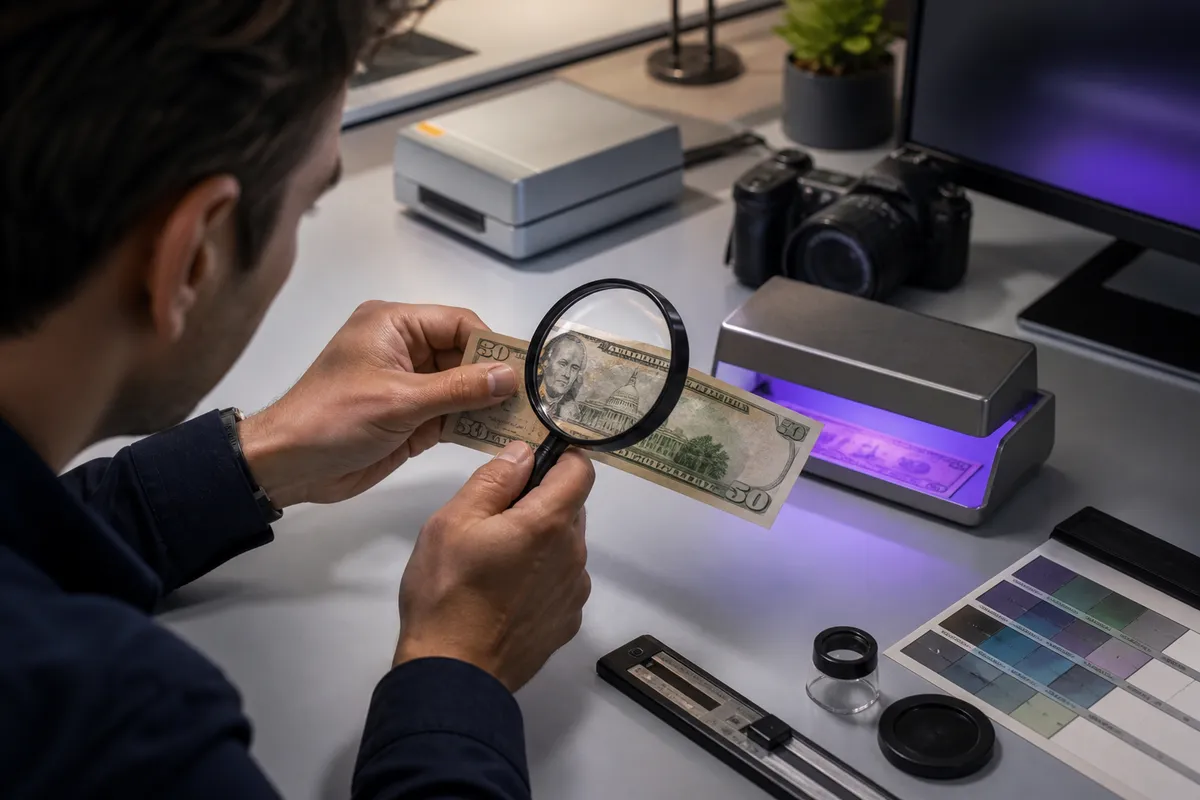
What Makes a $50 Bill Real: Key Security Features
To determine if a $50 bill is genuine, look for several key security features. These features help to distinguish real currency from counterfeit notes.
Watermark
A genuine $50 bill contains a watermark. This faint image resembles the portrait and is visible from both sides when the bill is held up to light. This feature is a reliable indicator of authenticity (1).
Security Thread
The security thread is a vertical strip of plastic embedded in the paper. It spells out “USA 50” in tiny print and can be seen from both sides when held to the light. This thread also glows a unique color under ultraviolet (UV) light, which is specific to the $50 denomination (1) (3).
Color-Shifting Ink
The numeral in the lower right corner of the bill uses color-shifting ink. When tilted, the ink changes color from copper to green. This effect is not only visually striking but also serves as a security feature that is difficult to replicate (1).
Microprinting
Microprinting can be found in various locations on a genuine $50 bill. This includes tiny text that is difficult to see without magnification. Check for this detail as counterfeiters often overlook such specifics (2).
Federal Reserve and Treasury Seals
Authentic $50 bills feature both the Federal Reserve Seal and the Treasury Seal. These seals are printed in distinct colors and are clearly defined. They should not be blurry or poorly defined, which can indicate a fake (3).
Serial Numbers
The serial numbers on the bill should be evenly spaced and printed in a consistent font. If the numbers appear misaligned or have irregular spacing, the bill may be counterfeit (4).
Raised Printing
Genuine currency has a unique texture due to raised printing. Run your fingers over the bill to feel for this texture. Most counterfeit notes do not replicate this feature effectively (3).
Using the “Look, Feel, Tilt” method recommended by the U.S. Secret Service can help verify the authenticity of a $50 bill. Look for these security features, feel the texture, and tilt the bill to check for color-shifting ink (2).
Understanding these security features helps to protect against counterfeit currency.
How to Spot a Fake $50 Bill: Common Red Flags
Identifying a fake $50 bill can be challenging, but certain indicators can help. Common red flags include jagged edges, missing security features, and incorrect ink colors. Here are some key features to compare when assessing a bill's authenticity.
Jagged Edges
Genuine $50 bills have smooth, clean edges. Counterfeit notes often exhibit jagged or rough edges. If the edges of a bill feel irregular, it may be fake.
Missing Security Features
The redesigned $50 bill, issued on September 28, 2004, includes essential security features such as a watermark, a security thread, and color-shifting ink (1). If any of these features are missing, the bill is likely counterfeit.
Watermark
A true $50 bill has a watermark that resembles the portrait of Ulysses S. Grant. This image is visible from both sides when held up to the light (1). If the watermark is absent or poorly defined, it raises suspicion.
Security Thread
The security thread is a vertical strip embedded in the paper, spelling “USA 50” in tiny print. This thread is visible from both sides when held to the light and glows under ultraviolet light (1) (3). Counterfeit bills often lack this feature or have poorly printed threads.
Color-Shifting Ink
The lower right corner of a genuine $50 bill uses color-shifting ink that changes from copper to green when tilted (1). If the color remains static, the bill may be fake.
Portrait Quality
The portrait of Ulysses S. Grant should be sharp and clear. Counterfeit bills often have blurry or poorly printed portraits.
Serial Numbers
Authentic $50 bills feature evenly spaced serial numbers in a consistent font. Misaligned or irregularly spaced numbers can indicate a counterfeit (4).
Microprinting and Texture
Microprinting is present in various locations on the genuine bill and is difficult to replicate. Additionally, genuine currency has a unique texture due to raised printing, which counterfeit notes often fail to mimic (3).
Law enforcement agencies, such as the Yankton Police Department, frequently issue alerts about counterfeit currency. They emphasize the importance of checking these features to avoid falling victim to counterfeit bills.
Being aware of these common red flags can significantly reduce the risk of accepting a fake $50 bill.
The Most Counterfeited Dollar Bills: Why $50?
The $50 bill is a popular target for counterfeiters, balancing value and circulation. It is less commonly circulated than the $20 bill but more accessible than the $100 bill. This makes it an attractive option for counterfeiters seeking to maximize their return on investment.
According to the U.S. Secret Service, in fiscal year 2023, the $20 bill was the most counterfeited denomination, accounting for a significant portion of the $102 million in counterfeit currency passed in the United States (5). While the $50 bill does not lead in counterfeiting, it still remains a frequent target due to its mid-range value. The stock of counterfeit U.S. currency is estimated at most to be $30 million, or about 1 in 40,000 notes (6). This suggests that while counterfeiters favor lower denominations like the $20, the $50 is still a viable option.
Historically, older designs of currency are easier to counterfeit. The redesigned $50 bill, released on September 28, 2004, improved security features, including a watermark, security thread, and color-shifting ink (1). These enhancements make it more difficult for counterfeiters to replicate the bill accurately. However, some counterfeiters still attempt to create fake versions of older, less secure designs.
The combination of factors—value, circulation, and historical context—contributes to the $50 bill's status as a common target for counterfeiting. Understanding these aspects can help individuals recognize the importance of checking security features when handling cash.
Realistic Prop Money: What It Is and How It Differs from Counterfeit
Prop money refers to imitation currency used primarily for film production, theater, and novelty items. It is designed to look realistic but is legally allowed as it does not intend to deceive anyone into accepting it as real money. Legal use cases for prop money include movie sets, stage performances, and promotional materials. The Counterfeit Detection Act of 1992 stipulates that prop money must either be one-sided or scaled to less than 75% or more than 150% of the actual currency size (7). This act ensures that prop money cannot be confused with real currency.
The main difference between prop money and counterfeit bills lies in their intended use and design. Counterfeit bills are created with the intent to defraud and mimic real currency closely. In contrast, prop money includes disclaimers stating it is not legal tender, often featuring phrases like “For Motion Picture Use Only.” Prop money also typically displays design variations that distinguish it from actual currency, such as unique serial numbers and different colors.
Features of prop money can include false watermarks, which may resemble those on genuine bills but do not hold the same authenticity. Some prop money may have distinctive serial numbers that do not correspond to any real currency. It is common for prop money to lack security features found in genuine bills, like security threads or color-shifting ink. However, some high-quality prop money attempts to replicate these features to enhance realism.
When using prop money, it is crucial to ensure compliance with legal guidelines. Always check for disclaimers and consider the context in which it will be used to avoid confusion with real currency.
Understanding these distinctions helps in recognizing the appropriate use of prop money while preventing legal issues.
Where to Buy Safe and Legal Prop $50 Bills
Finding safe and legal sources for purchasing prop $50 bills is essential for film production and novelty uses. Several reputable options exist that cater to these needs.
Reputable Sources
Specialized Prop Money Stores: Look for stores that specialize in prop money. These shops often provide a range of options, including various denominations and designs. They usually adhere to legal guidelines, ensuring their products are compliant with laws regarding prop currency.
Online Marketplaces: Websites like Amazon and eBay can be good platforms to find prop money. However, it is crucial to verify the seller’s reputation through customer reviews and ratings. Always check that the listings clarify the item is for prop use only.
Film Production Supply Companies: Some companies supply equipment and materials specifically for film production, including prop money. These suppliers typically understand the legal requirements and provide high-quality products.
What to Look for in a Seller
When choosing a seller for prop money, keep these factors in mind:
Transparency: The seller should provide clear information about their products, including disclaimers that the money is not legal tender. Look for phrases like “For Motion Picture Use Only.”
Legal Disclaimers: Ensure the product meets legal standards, such as being one-sided or scaled in size according to the Counterfeit Detection Act of 1992 (7).
Customer Reviews: Check reviews and ratings from previous buyers to assess the quality and reliability of the seller. Positive feedback can indicate a trustworthy source.
Warning Against Illegal or Low-Quality Options
Avoid sellers that do not provide clear disclaimers or attempt to pass off their products as real currency. Low-quality prop money may lack essential design features, making it easily identifiable as fake. This can lead to legal issues and unintended consequences.
Using reputable sources for prop money ensures compliance with legal standards while providing realistic options for film and novelty uses. Always prioritize transparency and quality when making a purchase.
Old vs. New $50 Bills: How to Verify Authenticity
The design of the $50 bill has evolved, impacting its security features. The older designs, particularly those printed before 1990, lack many of the advanced security measures present in the newer bills released after September 28, 2004.
Key Differences in Security Features
Watermark: Newer $50 bills include a watermark that resembles Ulysses S. Grant's portrait. This watermark is visible from both sides when held up to light (1). Older designs do not have this feature.
Security Thread: The redesigned bill features a vertical security thread embedded in the paper, which spells out “USA 50” in tiny print. This thread is visible from both sides and glows under UV light (1) (3). Older bills lack this security thread.
Color-Shifting Ink: The numeral in the lower right corner of the modern bill uses color-shifting ink, changing from copper to green when tilted (1). This feature is absent in older designs.
Microprinting and Background Colors: Enhanced features in the new bill include subtle background colors and microprinting, making it harder to counterfeit (1). Older bills do not possess these advanced attributes.
Checklist for Verifying Old Bills
Before accepting an old $50 bill, consider these verification steps:
Check for Watermark: Hold the bill up to light to see if the watermark is present.
Inspect the Security Thread: Look for the embedded security thread and ensure it spells “USA 50.”
Test Color-Shifting Ink: Tilt the bill to see if the numeral changes color.
Feel the Texture: Genuine currency has a unique texture due to raised printing.
Examine Microprinting and Background: Look for microprinting and vibrant background colors.
Examples of Outdated Features
Older $50 bills may include features no longer in use, such as:
One-Dimensional Features: Earlier designs lacked the multi-faceted security elements now standard in newer currency.
Simple Serial Numbers: Older bills had less sophisticated serial numbers, which can be irregularly spaced.
By familiarizing oneself with these differences, the reader can effectively identify authentic $50 bills from older designs and avoid counterfeit currency.
Common Misconceptions and Mistakes
Trusting Counterfeit Detection Pens Alone
Many rely on counterfeit detection pens as a foolproof method. These pens react to the starch in wood-based paper but can give false positives or negatives. The Federal Reserve explicitly warns against depending solely on them (4). Always combine pen tests with checks for watermarks, security threads, and color-shifting ink.
Assuming All Prop Money Is Illegal
Some believe any realistic-looking prop money is counterfeit. Legal prop money exists but must comply with the Counterfeit Detection Act of 1992, requiring it to be one-sided or scaled incorrectly (7). Look for disclaimers like “For Motion Picture Use Only” to confirm legality.
Ignoring the Back of the Bill
Counterfeiters often focus on replicating the front of the bill while neglecting the back. The U.S. Secret Service advises checking that the back is fully printed and lacks phrases like “For Motion Picture Use Only” (2). A blank or poorly printed reverse is a red flag.
Overlooking Older $50 Bill Designs
Older $50 bills lack modern security features like watermarks or color-shifting ink. The redesigned 2004 bill introduced these measures, but pre-1990 designs are more vulnerable to counterfeiting (1). Always verify the bill’s release year and corresponding features.
Confusing Prop Money with Counterfeit Bills
Prop money is often mistaken for counterfeit due to its realism. However, legal prop money includes clear disclaimers and design variations, such as unique serial numbers or altered sizes (7). Counterfeit bills, by contrast, aim to deceive and mimic real currency exactly.
Skipping the ‘Look, Feel, Tilt’ Method
The U.S. Secret Service recommends this simple three-step check: look for security features, feel the texture, and tilt the bill to observe color shifts (2). Skipping any step increases the risk of missing a fake.
Key Takeaways
Older $50 bills lack modern security features like watermarks and color-shifting ink, making them easier to counterfeit.
Legal prop money must include disclaimers and comply with size or one-sided requirements under the Counterfeit Detection Act of 1992 (7).
Always verify bills using the “look, feel, tilt” method to spot missing or poorly replicated security features.
Avoid sellers without clear legal disclaimers or transparent product descriptions.
For a deeper dive into spotting counterfeit currency, explore Fake US Dollars: How to Spot Them.
Good to know
How do you tell if a $50 bill is real?
Hold it up to the light to check for a faint watermark matching Ulysses S. Grant’s portrait on both sides (1). Look for a vertical security thread spelling 'USA 50' and color-shifting ink in the lower right numeral that changes from copper to green when tilted (1).
How can I identify a fake 50 dollar bill?
Use the ‘Look, Feel, Tilt’ method: look for missing watermarks or security threads, feel the texture for genuine cotton-linen paper, and tilt to check for color-shifting ink (2). Most fakes lack these features or replicate them poorly.
What is the most faked dollar bill?
The $20 bill is the most counterfeited denomination in the U.S., with $102 million in counterfeit currency passed in fiscal year 2023 (5). The $50 bill ranks lower but still requires verification.
Where to buy fake 50 dollar bill?
Legal prop $50 bills can be purchased from specialized prop money stores, film production suppliers, or reputable online marketplaces. Ensure the product is one-sided, scaled incorrectly, or includes disclaimers like 'For Motion Picture Use Only' (7).
How to spot a fake old $50 dollar bill?
Older $50 bills lack modern features like watermarks, security threads, or color-shifting ink. Check for raised printing, consistent serial numbers, and the absence of phrases like 'For Motion Picture Use Only' (1).
Sources and further reading
- Banks to begin distributing redesigned $50 bill--September 28, 2004 | Federal Reserve
- Learn How to Spot Fake Money Before it Reaches Your Wallet | United States Secret Service
- Know Your Money | U.S. Secret Service
- How do I determine if a banknote is genuine? | Federal Reserve
- Estimating the Volume of Counterfeit U.S. Currency in Circulation | Federal Reserve
- Estimating the Volume of Counterfeit U.S. Currency in Circulation | Federal Reserve
- Cinema Law: Can I Film U.S. Currency? - MovieMaker Magazine