Fake US Dollars: How to Spot Them
- First published:
- 15 min read
Why Counterfeit US Dollars Are a Real Threat
Counterfeit US dollars pose a significant threat to individuals and businesses. In fiscal year 2023, the U.S. Secret Service seized over $41.5 million in counterfeit currency globally, emphasizing the ongoing issue of fake dollars (3). Additionally, $102 million in counterfeit currency was passed to the public worldwide during the same period, with $21.8 million seized domestically (4).
Common scenarios where counterfeit bills often appear include small businesses, online transactions, and even pranks. Small retailers are particularly vulnerable, as they may not have the tools or knowledge to detect fake bills. Online transactions can also lead to the circulation of counterfeit currency, especially when buyers are not cautious.
The legal consequences of counterfeiting are severe. Under 18 U.S. Code § 471, creating or passing counterfeit currency can result in a prison sentence of up to 20 years (5). This applies not only to those who produce fake money but also to individuals who knowingly use it. If someone receives a suspected counterfeit bill, they should notify local authorities immediately, as counterfeit notes cannot be exchanged for real currency (2).
Understanding the scale of counterfeiting and its legal repercussions is vital for personal protection. Being informed can help individuals and businesses avoid the risks associated with fake currency.
Key Security Features of Real US Dollar Bills
Identifying real U.S. dollar bills requires attention to specific security features. Each denomination has unique characteristics to help you distinguish between genuine and counterfeit notes.
$20 Bill Features
Watermark: A portrait of Andrew Jackson appears on the right side. It is visible when held up to light.
Security Thread: A vertical thread that runs from top to bottom, embedded in the bill, is visible when held up to the light. It reads "USA TWENTY."
Color-Shifting Ink: The numeral "20" in the lower right corner shifts from copper to green when tilted.
Microprinting: Tiny text appears along the border of the bill and in the security thread.
$50 Bill Features
Watermark: A large portrait of Ulysses S. Grant can be seen when the bill is held to the light.
Security Thread: Located to the left of the portrait, it is embedded and reads "USA FIFTY."
Color-Shifting Ink: The numeral "50" shifts color similarly when tilted.
Microprinting: Features tiny text that can be found in various places on the bill.
$100 Bill Features
Watermark: Benjamin Franklin's portrait is visible when held to the light.
3-D Security Ribbon: A blue ribbon with images of bells and 100s shifts as you tilt the note. This feature is unique to the $100 bill.
Color-Shifting Ink: The ink shifts from copper to green on the numeral "100."
Microprinting: Found in various areas, enhancing the security of the note.
Differences Between Older and Newer Designs
The newer designs, introduced after 2013, feature enhanced security elements. For example, earlier versions of the $100 bill lacked the 3-D security ribbon. Older bills may not include the color-shifting ink or updated watermarks present in the newer series.
Being aware of these features is essential for personal protection against counterfeit currency. The U.S. Bureau of Engraving and Printing emphasizes that educated users are the first line of defense against counterfeiting (6).
How to Spot Fake US Dollars: Step-by-Step Guide
Verifying the authenticity of U.S. dollar bills can be straightforward if you follow a practical checklist. Here’s a step-by-step guide to help the reader distinguish between real and counterfeit currency.
Checklist for Verifying a Bill
Feel the Texture: Genuine bills have a unique texture. They are printed on special paper that feels different from regular paper. Run your fingers over the bill to check for this texture.
Tilt to Check Color-Shifting Ink: For denominations of $10 and higher, tilt the bill to observe the color-shifting ink. It should change from copper to green. This feature is particularly visible on the $100 bill (1).
Hold Up to Light for Watermark: Genuine bills feature a watermark that matches the portrait on the bill. Hold it up to the light to confirm its presence (1).
Check the Security Thread: Each denomination has a security thread embedded in the paper. This thread is visible when held up to light and contains text indicating the denomination (1).
Inspect Microprinting: Look for tiny text that is difficult to replicate. This microprinting can be found in various areas on the bill and is a key security feature (1).
Use a Counterfeit Detection Pen: A counterfeit detection pen can be used to check the ink on the bill. Genuine currency will react differently than counterfeit notes.
Comparison Table: Real vs. Fake Security Features
| Security Feature | Real Bill | Fake Bill |
|---|---|---|
| Texture | Distinct, rough feel | Smooth, regular paper |
| Color-Shifting Ink | Changes color when tilted | No color change or incorrect color |
| Watermark | Matches portrait, visible in light | No watermark or incorrect image |
| Security Thread | Embedded and visible in light | Printed or absent |
| Microprinting | Present and legible | Often missing or illegible |
Common Mistakes to Avoid
Relying solely on one feature, such as the hologram, can lead to mistakes. Counterfeiters often replicate individual features, making it crucial to use a combination of methods to verify authenticity. Always check multiple security features before concluding.
If a suspected counterfeit bill is received, notify local authorities immediately. Counterfeit notes cannot be exchanged for real currency and are illegal to use (2) (7).
Being aware of these verification techniques significantly enhances personal protection against counterfeit currency.
3 Levels of Counterfeit Cash (and How to Recognize Each)
Counterfeit cash can be categorized into three distinct levels based on quality and security features. Understanding these levels helps in identifying fake bills more effectively.
Level 1: Low-Quality, Obvious Fakes
These counterfeits are the easiest to spot. They often use inferior materials and lack essential security features. Signs include:
Poor Paper Quality: The texture feels smooth and regular, unlike genuine currency.
Inaccurate Colors: The colors may appear too bright or faded compared to authentic bills.
Missing Features: There are no watermarks, security threads, or microprinting.
Level 1 counterfeits are common in low-stakes environments, such as small transactions or pranks. They are often produced using home printers.
Level 2: Mid-Quality, Some Security Features
These fakes incorporate a few security elements, making them harder to detect but not perfect. Characteristics include:
Decent Paper Quality: The texture may resemble real bills but still feels off.
Partial Security Features: Some may have a security thread or color-shifting ink but not always correctly executed.
Inconsistent Microprinting: Microprinting might be present but may be illegible or poorly replicated.
Level 2 counterfeits often circulate in situations where the recipient may not closely inspect the bill.
Level 3: High-Quality, Near-Perfect Replicas
These counterfeits are sophisticated and can closely mimic genuine bills. Recognizing them requires careful examination. Features to look for include:
Excellent Paper Quality: The texture closely resembles that of real currency.
Advanced Security Features: This includes color-shifting ink, security threads, and accurate watermarks.
Missing Microprinting: High-quality fakes often lack the precise microprinting found on authentic bills.
Level 3 counterfeits are more prevalent in larger denominations, such as the $100 bill, which is the most frequently counterfeited denomination outside the U.S. (4).
In 2023, the U.S. Secret Service seized over $41.5 million in counterfeit currency, highlighting the ongoing threat of fake dollars in circulation (3). Understanding these levels can help individuals and businesses better protect themselves against counterfeit cash.
Tools to Detect Counterfeit Money (Without Special Equipment)
Detecting counterfeit money doesn't always require high-tech tools. Several simple, low-cost items can help identify fake bills effectively.
UV Light
A UV light can reveal hidden security features in U.S. currency. Genuine bills have fluorescent fibers woven into the paper, which glow under UV light. To use this tool, shine the UV light on the bill in a dark area. If the fibers glow brightly, the bill is likely genuine. However, counterfeiters can also add fake fibers, so this method should be used alongside others.
Magnifying Glass
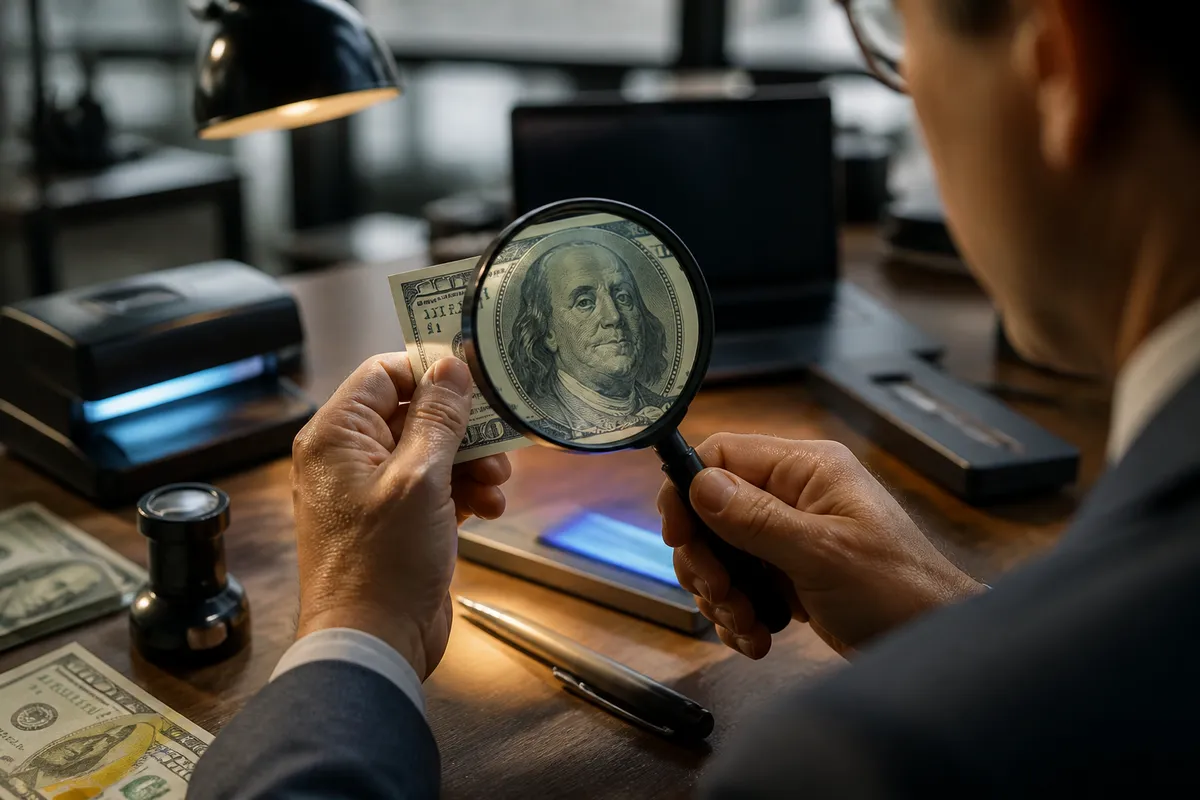
A magnifying glass is useful for inspecting microprinting and other fine details. Genuine bills contain tiny text that is difficult to replicate. Use the magnifying glass to check for microprinting in areas like the portrait or along the borders. If the text is unclear or missing, the bill may be counterfeit.
Counterfeit Detection Pen
Counterfeit detection pens are affordable and easy to use. When you mark a bill with the pen, the ink will react differently on genuine currency compared to fakes. Genuine bills will leave a light yellow mark, while counterfeit bills may turn dark. However, this method has limitations; some counterfeiters use similar paper, which can yield false positives. Therefore, it’s best to use this tool as part of a broader inspection process.
When to Use Professional Equipment
For businesses or individuals frequently handling cash, investing in professional counterfeit detection equipment may be wise. Machines that scan bills and verify their authenticity can provide more reliable results. If you are in a high-risk environment, such as a retail store, consider using professional tools to minimize the risk of accepting counterfeit currency.
Using these tools effectively can enhance your ability to detect counterfeit bills. Always combine methods for the best results.
What to Do If You Receive a Fake Bill
Receiving a fake bill can be alarming. It's essential to take immediate action to protect yourself and others. Here's a step-by-step guide on what to do if you find yourself in this situation.
Step 1: Do Not Pass It On
Avoid trying to use or pass the counterfeit bill to someone else. Doing so is illegal and can lead to serious consequences. Under 18 U.S. Code § 471, passing counterfeit currency can result in a prison sentence of up to 20 years (5).
Step 2: Note the Details
Take note of the bill's serial number and where you received it. These details can be crucial for law enforcement when investigating the counterfeit case. Write down any relevant information, including the time and place of the transaction.
Step 3: Contact Authorities
Notify local law enforcement or the U.S. Secret Service immediately. They are trained to handle counterfeit currency cases. The U.S. Secret Service has a dedicated process for reporting suspected counterfeit notes. As of November 1, 2024, individuals must contact their local U.S. Secret Service field office directly (8).
Step 4: Do Not Attempt to Exchange the Bill
Be aware that banks and financial institutions are not required to reimburse customers for counterfeit bills. The U.S. Federal Reserve states that counterfeit currency has no value and cannot be exchanged for genuine money (7).
Reporting Resources
For additional guidance, consider visiting the U.S. Secret Service website. They provide resources to help individuals report counterfeit currency and understand the proper procedures.
Taking these steps seriously can help mitigate the risk associated with counterfeit bills. Being informed and proactive is a critical defense against this ongoing issue.
Prop Money vs. Counterfeit Money: Legal and Practical Differences
Prop money is designed for use in films, theatrical productions, and pranks. It mimics real currency but is not intended for actual transactions. Most importantly, prop money is marked with phrases like “FOR MOTION PICTURE USE ONLY” to distinguish it from authentic banknotes. This clear labeling helps prevent confusion and misuse.
Legal requirements for prop money are strict to avoid any resemblance to real currency. According to U.S. regulations, prop money must meet specific size and color standards, ensuring it does not closely imitate actual denominations. For example, it should not be the same size as real bills and must generally be printed on paper that differs from the texture of genuine currency. This is essential to prevent any legal issues or misunderstandings.
Using prop money in real transactions poses significant risks. If someone attempts to use prop money as real currency, they can face serious legal consequences. Counterfeiting, which involves making or distributing fake currency with the intent to defraud, is punishable by up to 20 years in prison under 18 U.S. Code § 471 (5). Even if prop money is not intended for this purpose, the lack of proper labeling or misunderstanding can lead to severe repercussions.
In summary, while prop money serves a legitimate purpose in entertainment, it is crucial to understand its legal limitations and the risks of using it in real-life scenarios.
Common Myths About Fake US Dollars Debunked
Misconceptions about counterfeit US dollars can lead to false security or unnecessary panic. Here are some common myths and the facts that debunk them.
Myth 1: All fake bills feel flimsy
While many low-quality counterfeits do have a flimsy texture, high-quality fakes can closely mimic the feel of real bills. Some counterfeiters use advanced materials that replicate the texture of genuine currency, making them harder to detect by touch alone. Always combine tactile inspection with visual checks to ensure authenticity.
Myth 2: Counterfeit pens are 100% reliable
Counterfeit detection pens can be useful but are not foolproof. Genuine bills will usually leave a light yellow mark, while fakes may turn dark. However, some counterfeiters use similar paper that can yield false positives. Relying solely on a pen can lead to mistakes, so it's essential to use multiple verification methods, including checking security features like watermarks and security threads (1).
Myth 3: Counterfeit bills are always easy to spot
Not all counterfeit bills are poorly made. In fact, the U.S. Secret Service seized over $41.5 million in counterfeit currency in 2023, showcasing the sophistication of some fakes (3). High-quality counterfeits may include advanced features like color-shifting ink and microprinting, making them difficult to distinguish from real bills without careful examination (1).
Myth 4: You can easily exchange a counterfeit bill at the bank
Counterfeit currency has no value and cannot be exchanged for real money. Banks are not required to reimburse customers for counterfeit bills they receive (7). If you suspect you have a counterfeit, it is crucial to report it to local authorities or the U.S. Secret Service. Passing counterfeit currency can lead to legal repercussions, with penalties of up to 20 years in prison (5).
Myth 5: Only low denominations are counterfeited
Contrary to popular belief, high denominations are often targeted by counterfeiters. The $100 bill is the most frequently counterfeited outside the U.S., while the $20 bill is the most common domestically (4). Understanding which denominations are at risk can help individuals and businesses stay vigilant.
Awareness of these myths and the facts behind them empowers the reader to better protect themselves against counterfeit currency.
Common Mistakes and Misconceptions
Relying solely on the feel of the bill
Many assume genuine bills always have a distinct texture. While real currency uses a unique cotton-linen blend, high-quality counterfeits can replicate this feel. Touch alone isn’t enough—always pair it with visual checks like security threads or color-shifting ink (1).
Trusting a counterfeit pen without backup
Detection pens react to the starch in most counterfeit paper, but savvy counterfeiters use starch-free paper or bleached genuine bills. A pen’s mark can mislead—combine it with other methods like UV light or magnifying glass (1).
Ignoring the denomination’s security features
Not all bills have the same protections. The $100 bill includes a 3-D security ribbon and color-shifting bell, while the $20 lacks these (1). Assuming all denominations share features leads to missed red flags.
Assuming banks will replace counterfeit bills
Banks have no obligation to reimburse customers for fake currency (7). Once a counterfeit is in your hands, it’s worthless—report it to law enforcement instead of trying to exchange it (2).
Confusing prop money with counterfeit
Prop money for films is legal but must be clearly marked and differ in size or color from real bills. Passing it as genuine is illegal and punishable by up to 20 years in prison (5).
Mistakes often stem from overconfidence in a single method—always verify with multiple checks.
Key Takeaways
Always use multiple detection methods—UV light, magnifying glass, and pens—to catch inconsistencies.
Never pass or attempt to exchange a suspected counterfeit bill; it’s illegal and punishable by law.
Prop money is legal only if clearly marked and not used as real currency.
High-quality fakes can mimic real bills, so rely on security features, not just texture or denomination.
Report counterfeit bills to the U.S. Secret Service or local law enforcement immediately.
For a deeper understanding of counterfeit risks, read Counterfeit 101: Understanding the Basics Without Getting Burned.
Good to know
How can you identify a fake dollar?
Use the 'Feel, Tilt, Check' method: genuine bills have color-shifting ink, watermarks, and security threads. For $100 notes, look for the 3-D security ribbon and color-shifting bell in the inkwell (1). Always verify with multiple features, as high-quality fakes can mimic some details.
What is the best realistic prop money available?
The best prop money is clearly marked with phrases like “FOR MOTION PICTURE USE ONLY” and differs in size or color from real currency. It must not closely imitate genuine bills to comply with U.S. regulations. Avoid any unmarked or realistic-looking replicas.
How much jail time for fake money?
Counterfeiting U.S. currency is punishable by up to 20 years in prison under 18 U.S. Code § 471. This applies to making, forging, or altering currency with intent to defraud (5).
Will banks replace fake money?
Banks are not required to reimburse customers for counterfeit bills. Counterfeit money has no value and cannot be exchanged for genuine currency (7).
Fake $100 dollar bill vs real
A real $100 bill has a 3-D security ribbon with shifting bells and 100s, plus a color-shifting bell in the inkwell. Fake versions often lack these features or replicate them poorly (1). Always compare under light and tilt to spot differences.
Sources and further reading
- U.S. Currency Education Program: Feel-Tilt-Check Card (2024)
- Federal Reserve: How to Handle Suspected Counterfeit Currency
- U.S. Secret Service FY 2023 Annual Report
- Federal Reserve: Estimating the Volume of Counterfeit U.S. Currency in Circulation
- 18 U.S. Code § 471: Obligations or securities of United States
- Bureau of Engraving and Printing: Circulating Currency Security Features
- HelpWithMyBank.gov: Counterfeit Bill Policy
- U.S. Currency Education Program: Reporting Suspected Counterfeit Currency