Counterfeit 20 Dollar: Identifying Features
- First published:
- 14 min read
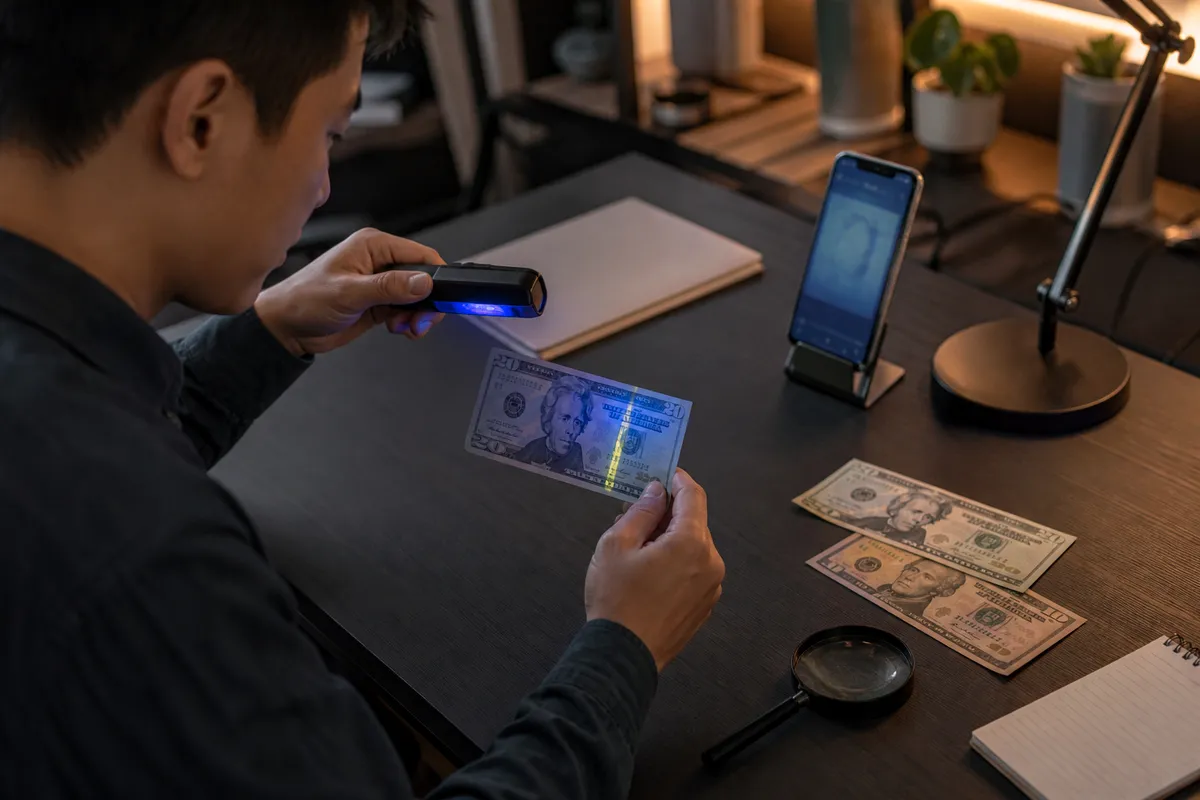
Security Thread: The Hidden Glow
The $20 bill features an embedded security thread that glows green under ultraviolet (UV) light. This thread is located vertically to the left of President Jackson’s portrait. When exposed to UV light, the thread is clearly visible and displays the text “USA TWENTY” along with a small flag. This feature can be a reliable indicator of authenticity, as genuine bills will consistently exhibit this glowing property (1).
Counterfeit bills often lack this security thread altogether or may present a poorly replicated version. Many counterfeiters do not have the capability to accurately reproduce this critical feature. Therefore, checking for the security thread should be one of the first steps when assessing a $20 bill for authenticity.
To effectively use this feature in your verification process, consider the following steps:
Obtain a UV light source: A simple UV flashlight can be an effective tool.
Shine the UV light on the bill: Position the light close to the bill, ensuring even coverage.
Look for the glow: A genuine $20 bill will exhibit a bright green glow from the security thread.
If the bill does not glow or the thread appears faded or absent, it is likely counterfeit. Always remember that genuine U.S. currency is designed with several security features that work in tandem to prevent counterfeiting.
Relying solely on one feature, such as the security thread, is not enough. It's best to verify multiple security features to ensure the bill's authenticity.
This hidden glow is just one part of a larger set of security measures designed to protect against fraud.
Watermark: The Portrait in the Light
The watermark on a genuine $20 bill features a faint image of President Andrew Jackson. This watermark is located in the blank space to the right of Jackson's portrait. When held up to the light, it becomes visible from both the front and back of the bill (1). This is an essential feature for identifying authenticity, as counterfeit bills often have blurry or missing watermarks.
To check the watermark, follow these steps:
Hold the bill up to a light source: Natural light or a lamp works well.
Look for the portrait of Jackson: The image should be clear and match the portrait on the front of the bill.
Check for clarity: Genuine watermarks will be distinct and not blurry.
A blurry or absent watermark is a red flag. Counterfeiters often struggle to replicate this feature accurately. In many cases, they might attempt to print a watermark, but the result tends to lack the quality found in authentic currency.
It's important to remember that the watermark is just one of several security features on a $20 bill. Other elements include the security thread, color-shifting ink, and raised printing. Each feature serves to enhance the bill's security and authenticity.
When verifying a $20 bill, do not rely solely on the watermark. Examine multiple features to confirm authenticity. This comprehensive approach will significantly reduce the risk of accepting counterfeit currency.
Color-Shifting Ink: The Changing Numbers
The $20 bill features a unique color-shifting ink in the lower right corner. When tilted, the numeral "20" transitions from copper to green. This effect is a key security feature that enhances the bill's authenticity (1).
Counterfeiters often find it challenging to replicate this color-shifting ink accurately. Many counterfeit bills will either lack this feature or display a poor imitation that doesn't change color as intended. This makes it a reliable indicator when assessing a $20 bill.
To check for the color-shifting ink, follow these steps:
Tilt the bill: Hold the bill at a slight angle under a light source.
Observe the numeral "20": Look for the color change from copper to green. This shift should be smooth and noticeable.
Compare with a genuine bill: If possible, have a real $20 bill for comparison to see the difference.
The color-shifting ink should exhibit a vibrant transition. If the color change is absent or minimal, it may indicate that the bill is counterfeit.
In addition to the color-shifting ink, remember to check other security features such as the security thread and watermark. Each feature plays a role in confirming the bill's authenticity.
The color-shifting ink is a distinctive characteristic of genuine $20 bills, making it a critical element for identification.
Raised Printing: Feel the Texture
Genuine $20 bills have a unique texture due to raised printing. This feature is particularly noticeable on the portrait of President Jackson, the borders, and other detailed areas. The printing process used for U.S. currency is called intaglio. This method creates a slightly rough feel when touched, distinguishing authentic bills from counterfeits (2).
To verify the raised printing, run your fingernail across these areas. You should feel a subtle texture that is absent in counterfeit bills, which typically have flat and smooth printing. Counterfeiters often struggle to replicate this feature accurately, making it a reliable indicator of authenticity.
Here’s how to check for raised printing effectively:
Hold the bill firmly: Ensure you have a good grip on the edges.
Run your fingernail across the portrait: Pay close attention to Jackson’s image. You should feel a noticeable texture.
Check the borders and text: Move your fingernail across the borders and any printed text. Authentic bills will feel rough in these areas.
If the bill feels smooth or lacks texture, it is likely counterfeit. Counterfeit bills often miss the nuanced details that come from the intaglio printing process.
In addition to raised printing, other features like the security thread, watermark, and color-shifting ink should also be checked to confirm authenticity. Each of these features works together to protect against fraud.
The tactile sensation of raised printing is a simple yet effective method to help identify genuine $20 bills.
Microprinting: Tiny Details That Matter
Microprinting is a subtle yet crucial feature on genuine $20 bills. This tiny text can be found in various locations, including the phrase "USA20" around President Jackson's portrait and "THE UNITED STATES OF AMERICA" along the borders. These details are not just for decoration; they serve as a security measure to deter counterfeiting.
Genuine microprinting is sharp and legible when viewed under magnification. In contrast, counterfeit bills often exhibit blurry or missing text. This is a significant giveaway, as counterfeiters struggle to replicate the precision of authentic microprinting.
To check for microprinting, look closely at the following areas:
Around the Portrait: Inspect the area surrounding Jackson's image for the "USA20" text.
Borders: Examine the borders of the bill for the phrase "THE UNITED STATES OF AMERICA."
Using a magnifying glass can help reveal these tiny details. If the text is unclear or indistinct, it likely indicates a counterfeit bill.
In addition to microprinting, remember to verify other security features like the security thread, watermark, and color-shifting ink. Each of these elements plays a vital role in confirming the bill's authenticity.
Checking for microprinting is a simple yet effective step in identifying genuine $20 bills.
Federal Reserve and Treasury Seals: Official Marks
The Federal Reserve Seal and the Treasury Seal are essential features on a genuine $20 bill. The Federal Reserve Seal is located to the left of President Jackson’s portrait, while the Treasury Seal is positioned to the right. Both seals play a crucial role in verifying the authenticity of the bill (3).
Genuine seals exhibit fine, sharp details. They are well-defined and clear, making them easy to distinguish. In contrast, counterfeit bills often display smudged or poorly defined seals. This lack of clarity is a significant indicator that the bill may not be authentic.
The colors of the seals also provide clues. The Federal Reserve Seal is black, while the Treasury Seal is green. This color distinction is important when assessing a bill. If the colors appear faded or incorrect, it raises a red flag about the bill's authenticity.
To check the seals effectively, follow these steps:
Examine the seals closely: Use good lighting to enhance visibility.
Look for sharp details: Genuine seals should have crisp lines and clear lettering.
Check the colors: Ensure the Federal Reserve Seal is black and the Treasury Seal is green.
If you notice any blurriness or color inconsistencies, the bill might be counterfeit. Counterfeiters often struggle to replicate the precise details and colors found in genuine currency.
Relying on the seals is just one part of verifying a $20 bill. Always check multiple features, such as the security thread, watermark, and color-shifting ink. This comprehensive approach will significantly reduce the risk of accepting counterfeit currency.
Serial Numbers: Unique Identifiers
Serial numbers on a $20 bill are critical for identifying authenticity. Each bill features a unique serial number consisting of 11 characters, including both letters and numbers. These serial numbers appear twice on the front of the bill. The first letter corresponds to the series year, while the second letter indicates the issuing Federal Reserve Bank, ranging from A to L (4).
Genuine serial numbers are printed with precise alignment and consistent spacing. The font used is a bold, clear typeface that is easy to read. If the serial numbers appear misaligned, unevenly spaced, or poorly printed, it may indicate a counterfeit bill. Counterfeiters often struggle to replicate the exact font and spacing of genuine serial numbers, leading to discrepancies.
In 2023, the U.S. Currency Program began producing nonsequential $20 bills. This means that serial numbers may no longer follow a consecutive pattern and could contain gaps. While this may seem unusual, it’s a legitimate change in production.
To check the serial numbers effectively, follow these steps:
Examine the positioning: Ensure the numbers are located in the correct areas on the bill.
Look for consistency: Check for even spacing and alignment between the two serial numbers.
Compare with a genuine bill: If possible, reference a known authentic $20 bill for comparison.
If the serial numbers are mismatched or poorly printed, it is a strong indication that the bill is counterfeit. Always remember that verifying serial numbers is just one part of assessing a $20 bill's authenticity. Other features, such as the security thread, watermark, and color-shifting ink, should also be checked to confirm legitimacy.
Vigilance in examining serial numbers can help reduce the risk of accepting counterfeit currency.
Paper Quality: The Feel of Authenticity
Identifying counterfeit $20 bills involves examining the paper quality. Genuine U.S. currency is made from a unique blend of 75% cotton and 25% linen, known as rag paper. This composition gives authentic bills a distinct texture and durability that counterfeiters struggle to replicate (5).
When handling a genuine $20 bill, it feels crisp and slightly rough to the touch. This texture is a result of the intaglio printing process, which creates raised printing on the bill, particularly around the portrait of President Jackson and the borders (2). In contrast, counterfeit bills often feel smooth or flimsy. If a bill feels overly smooth or too light, it is likely counterfeit.
Another important aspect is how genuine bills react to handling. Authentic $20 bills do not tear easily and produce a distinct sound when snapped between fingers. This sound is a sign of the bill's sturdiness. Counterfeit bills may tear more easily and lack this characteristic sound, further indicating their inauthenticity.
To assess the paper quality effectively, consider these steps:
Feel the bill: Run your fingers over the surface to check for texture.
Check for durability: Gently tug on the corners to see if it tears easily.
Snap the bill: Listen for the sound it makes. A genuine bill has a crisp snap.
If the bill feels flimsy or smooth, it likely is not genuine. Remember, examining the paper quality is just one part of identifying counterfeit bills. Always check for other security features, such as the security thread, watermark, and color-shifting ink.
The feel of authenticity is a crucial indicator when assessing $20 bills.
Common Counterfeit Mistakes: Red Flags to Spot
Counterfeit $20 bills often exhibit several common mistakes that can help identify them. Here are key red flags to look for:
Mismatched Colors and Blurry Images
Authentic $20 bills have specific color schemes, including vibrant green and black. If the colors appear faded or mismatched, it raises suspicion. Blurry images, especially of President Jackson's portrait, are also indicators of counterfeiting. Genuine bills have sharp, clear images due to high-quality printing.
Missing Security Features
Counterfeit bills frequently lack essential security features. The security thread, which glows green under UV light, is embedded vertically to the left of Jackson's portrait (1). If this thread is absent or poorly replicated, the bill is likely counterfeit. Additionally, the watermark featuring Jackson, visible when held to light, should be faint but clear (1).
Poor-Quality Printing
Genuine $20 bills use intaglio printing, creating a tactile feel on the portrait and borders. If the printing feels smooth or flat, this is a strong sign of a counterfeit (2). Counterfeit bills often lack the raised texture and may have uneven edges or poorly defined borders.
Color-Shifting Ink
The numeral "20" in the lower right corner should shift color from copper to green when tilted (1). If this color change is absent or inconsistent, the bill is likely fake.
Serial Numbers and Seals
Each $20 bill has a unique serial number, printed twice on the front. If the numbers appear misaligned or poorly printed, this indicates counterfeiting (4). The Federal Reserve Seal (black) and the Treasury Seal (green) should also be clear and sharp. Any blurriness suggests inauthenticity (3).
Paper Quality
Authentic bills are made of 75% cotton and 25% linen, giving them a distinct texture. If the paper feels flimsy or too smooth, it is likely counterfeit (5). Genuine bills produce a crisp sound when snapped, which is often absent in counterfeits.
Summary of Common Mistakes
Mismatched colors or blurry images
Missing or poorly replicated security features
Poor-quality printing and uneven edges
Absent or inconsistent color-shifting ink
Misaligned or poorly printed serial numbers
Blurry Federal Reserve and Treasury Seals
Flimsy or overly smooth paper quality
Being aware of these common mistakes can significantly reduce the risk of accepting counterfeit currency. Always examine multiple features to confirm authenticity.
Common Misconceptions and Mistakes
Relying solely on counterfeit detection pens
Many assume a detection pen’s mark is enough to confirm a bill’s authenticity. These pens react to the starch in wood-based paper but can give false positives or negatives, especially with high-quality counterfeits (6). Always cross-check with other features like the watermark or security thread.
Ignoring the color-shifting ink
Some overlook the color change in the lower right corner’s “20.” Genuine bills shift from copper to green when tilted (1). If the number stays static, the bill is likely fake.
Assuming all serial numbers are sequential
Since 2023, $20 bills may have nonsequential serial numbers due to updated printing processes. Gaps or jumps in numbers don’t automatically mean counterfeit—focus on font clarity and alignment instead.
Trusting blurry watermarks or security threads
A faint watermark of Jackson should appear on both sides when held to light (1). A missing or poorly defined watermark is a red flag. The security thread should glow green under UV and contain “USA TWENTY” (1).
Overlooking paper texture
Genuine bills feel slightly rough due to their cotton-linen blend and raised printing (2) (5). Smooth or flimsy paper is a sign of a counterfeit. Always compare the feel to a known authentic bill.
Disregarding prop money warnings
Bills labeled “For Motion Picture Use Only” or “Replica” are not legal tender (2). These are often sold as props but can be mistaken for real currency.
Key Takeaways
Check multiple features: No single element confirms authenticity—examine seals, serial numbers, paper texture, and color-shifting ink.
Prioritize the watermark and security thread: These are the hardest to replicate and most reliable for quick verification.
Feel the bill: Genuine $20s use cotton-linen paper with a distinct texture and crisp snap.
Ignore sequential serial numbers: Nonsequential patterns are now standard, but poor alignment or font is a red flag.
For a deeper dive into spotting fakes, explore Check Counterfeit Money: A Step-by-Step Guide.
Good to know
How to tell if a $20 bill is counterfeit?
Hold the bill to light to check for the watermark of Andrew Jackson on the right side (1). Tilt the bill to see if the '20' in the lower right corner shifts from copper to green (1). Run your fingers over the portrait and borders to feel the raised printing from intaglio (2).
What does a fake 20 look like?
A fake $20 often has blurry images, mismatched colors, or missing security features like the glowing green thread under UV light (1). The paper may feel smooth or flimsy instead of crisp and textured (5). The color-shifting ink on the '20' may not change when tilted (1).
Sources and further reading
- $20 Note – U.S. Currency Education Program
- CEP Quick Glance Reference Card – U.S. Currency Education Program (2024)
- $20 Note – U.S. Currency Education Program
- Serial Numbers – Bureau of Engraving and Printing
- Training Course – Security | U.S. Currency Education Program
- Federal Reserve FAQ: How to Determine If a Banknote Is Genuine
- 18 U.S.C. § 472: Uttering Counterfeit Obligations or Securities